



United Nations, Oct 31 (IANS) India has asked the Human Rights Council to continue giving “sustained attention” to the threat of terrorism, which poses one of “the gravest threats” to human rights.
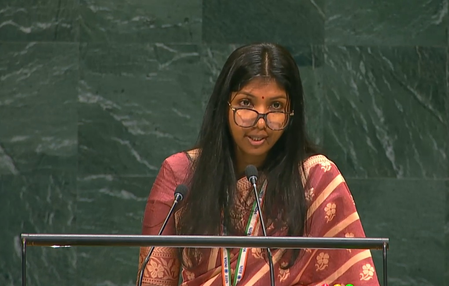
“Terrorism remains among the gravest threats to the enjoyment of human rights, above all, the right to life”, Bhavika Mangalanandan, a first secretary in India’s UN mission, told the General Assembly in New York on Friday,
She said the Human Rights Council has recognised this danger in its resolution on international cooperation this year, and India “would encourage the Council to give this threat the sustained attention it warrants on the basis of zero tolerance”.
The resolution, adopted by the Council in July in Geneva, where it is located, called on the international community to “take the steps necessary to enhance cooperation to prevent and combat terrorism”.
The resolution “re-emphasises that acts, methods and practices of terrorism in all its forms and manifestations are activities aimed at the destruction of human rights, fundamental freedoms and democracy, threatening the territorial integrity and security of States and destabilising legitimately constituted governments”.
This resolution runs counter to attempts by some countries, especially Pakistan, to create tendentious distinctions between terrorist acts and justify some.
Mangalanandan, who spoke at the General Assembly’s debate on the Human Rights Council’s report.
She criticised the Council’s attempts to “weaponise” the issue of human rights and to follow double standards, which undermines its credibility.
“Human rights are best advanced through dialogue, capacity building and genuine partnerships, and not by politicisation, selectivity or double standards”, she said. “This is critical if the Council is to speak in one voice and dispel the allegation of weaponisation of human rights”.
Stressing the importance of cooperation and dialogue, she said, “Country-specific mandates pursued without the engagement of the country concerned seldom improve the situation on the ground”.
“On the contrary”, she warned, “they deepen ‘divisions within the Council ‘”.
“The Universal Periodic Review, which was built on cooperation, engagement with member states concerned and treats all states equally, remains the appropriate platform”, she said.
The review, done every four or five years, is based on reports by the countries themselves on the human rights situation, reports by UN bodies and experts, and inputs from civil society groups, rather than a unilateral critique.
Mangalanandan was also critical of the blinkered approach to human rights that focuses mostly on political and civil rights at the expense of other rights.
“All human rights must be treated in a fair and equal manner on the same footing and with the same emphasis”, she said.
“Economic, social and cultural rights and the right to development deserve the same attention as civil and political rights for much of the developing world”, she stressed.
In many of the developing countries, she pointed out, “poverty, debt and limited access to financing and technology remain the most immediate obstacles to the enjoyment of human rights”.
“These call for international cooperation and not coercion”, she said.
–IANS
al/rs