



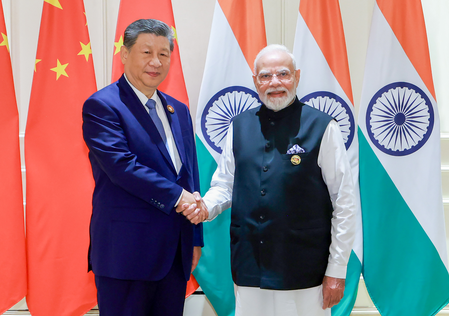
New Delhi, Sep 19 (IANS) The latest effort to stabilise India-China relations, underscored during the meeting between Prime Minister Narendra Modi and Chinese President Xi Jinping on the sidelines of the 18th BRICS Summit in New Delhi last week, needs to be viewed through a pragmatic lens, a report has stated.
In his bilateral talks with Xi, Prime Minister Modi stressed that the two sides must remain sensitive to each other’s core issues and allow ties to be guided by the “three mutuals” — mutual respect, mutual sensitivity and mutual interest, with both leaders echoing the same spirit during their meeting.
Writing for ‘Saviours’, Ashok Kumar Abrol, a former Indian Police Service (IPS) officer, said that while the engagement can create space for improved ties, it cannot overnight turn the two countries into friends or erase the historical legacy of 1962 and resolve their strategic differences.
However, he said, if dialogue leads to greater stability, predictable trade, improved market access and more reliable supply chains, it could create an economic environment that benefits both countries.
“For India, this matters even more. The world is looking for alternatives and additional manufacturing centres. India possesses a huge domestic market, a young workforce, expanding infrastructure, digital capabilities and a growing entrepreneurial ecosystem. But becoming the world’s second manufacturing hub will not happen simply because some factories move out of China,” wrote Abrol.
“India must create the conditions that make the country competitive in its own right. That requires reliable infrastructure, competitive energy, skilled manpower, efficient logistics, stable regulations, technological capability and—above all—a much greater commitment to research and development,” he added.
According to the Saviours’ report, the most pragmatic approach towards China is neither confrontation nor capitulation, but a balance of strength without belligerence, self-reliance without isolation, competition without hostility and cooperation without dependence.
“India does not need to become another China. Nor does India need to defeat China to succeed. It needs to become sufficiently innovative, productive and technologically self-confident to engage China—and the world—from a position of strength. And China, if it wishes to play the role of a responsible global power, must recognise that a prosperous and stable India need not be an adversary,” mentioned the former IPS officer.
“The future of Asia will not be determined merely by which country becomes stronger. It will also depend on whether its two largest civilisations can learn to manage their differences with maturity.
Differences are inevitable. Disputes are manageable. Conflict is avoidable. And cooperation need not mean surrender,” he stressed.
The report noted that India’s real achievement would be to develop the economic and technological strength that allows it to look across the Himalayas with confidence rather than fear or hostility. Ultimately, the best way to prevent differences from turning into disputes is not to erase them, but to build the strength, confidence and wisdom needed to manage them effectively.
“It is heartening to note that the theme of BRICS — ‘Resilience, Innovation, Cooperation & Sustainability’ — resonates perfectly with our basic premise: ‘Differences should not be allowed to grow into disputes’,” the Saviours report stated.
–IANS
scor/as