



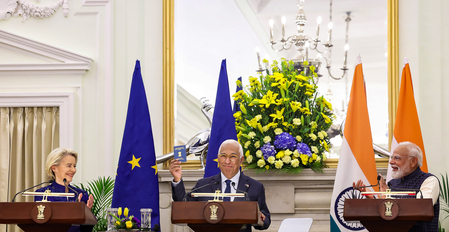
New Delhi, Jan 27 (IANS) The India-EU free trade agreement (FTA), together with the government’s recent FTAs with the UK and the European Free Trade Association (EFTA), effectively opens the entire European market for Indian exporters — marking a strategic breakthrough in India’s trade diplomacy, the Federation of Indian Export Organisations (FIEO) said on Tuesday.
The EU agreement comprehensively covers trade in goods and services, rules of origin, customs facilitation, trade remedies, and emerging areas such as digital trade and MSMEs.
It includes robust mechanisms to address non-tariff barriers — an outcome of the Government’s proactive engagement with EU regulators — through enhanced regulatory cooperation, transparent SPS measures, and streamlined customs procedures.
“The calibrated and quota-based liberalisation in the automobile sector will allow EU manufacturers to introduce advanced models in India, while creating future opportunities aligned with the Government’s ‘Make in India’ and ‘Atmanirbhar Bharat’ initiatives,” said SC Ralhan, President, FIEO.
The European Union is among India’s largest trading partners. In FY 2024–25, India–EU bilateral trade in goods stood at Rs 11.5 lakh crore ($136.54 billion), with exports of Rs 6.4 lakh crore ($75.85 billion) and imports of Rs 5.1 lakh crore ($ 60.68 billion). Trade in services reached Rs 7.2 lakh crore ($83.10 billion).
Ralhan stated that the successful conclusion of the India-EU FTA will significantly enhance India’s export competitiveness and provide a powerful thrust to India’s engagement with global value chains.
This agreement opens unprecedented market access for Indian exporters across goods and services, particularly empowering labour-intensive sectors, MSMEs, women entrepreneurs, artisans, and youth—core focus areas of the Government’s inclusive growth agenda.
With tariff elimination of up to 10 per cent on nearly $33 billion worth of Indian exports, the FTA will provide immediate and tangible gains to key sectors such as textiles, apparel, leather, footwear, gems and jewellery, engineering goods, marine products, handicrafts, and automobiles.
These benefits will translate into higher exports, large-scale employment generation, and stronger grassroots participation in global trade, reinforcing the Government’s vision of export-led prosperity.
The Indian consumers are expected to benefit from improved access to high-technology products and increased competition. Agriculture and processed food exports will receive a major boost, with enhanced market access for tea, coffee, spices, fruits, vegetables, and processed foods, while the Government has prudently safeguarded sensitive sectors such as dairy and cereals, ensuring farmer interests remain fully protected.
–IANS
na/