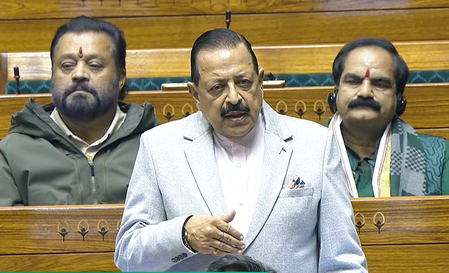
New Delhi, Dec 17 (IANS) India has achieved self-reliance in space transportation systems and can launch satellites up to 10 tonnes to Low Earth Orbit (LEO) and 4.2 tonnes to Geo-Synchronous Transfer Orbit (GTO), said Jitendra Singh, Union Minister of State (Independent Charge) for Science and Technology, in the Parliament on Wednesday.
In a written reply in the Lok Sabha, Singh shared that the feat has been achieved through the currently operational PSLV, GSLV, and LVM3 launch vehicles.
“These launch vehicles have enabled independent space access to satellites for earth observation, communication, navigation, and space exploration. In order to enhance the launch vehicle capabilities towards meeting the expanded space vision, the government has approved the development of a Next Generation Launch Vehicle (NGLV), which will provide a maximum payload capability of 30 tons to Low Earth Orbit,” Singh said.
“Towards achieving low-cost access to space, reusable launch vehicle technologies are also being developed, including a partially reusable variant of NGLV with 14 tonnes payload capability to LEO. Another development is of a winged body upper stage which will fly back from the orbit to the Earth and autonomously land on a runway,” he added.
The Minister further informed that ISRO has undertaken the development of a high-thrust (2000kN) semi-cryogenic engine for inducting in the LVM3 vehicle.
In addition, an environmentally friendly methane-based propulsion system for a high-thrust engine is also being conceptualised for NGLV.
The “development of an air-breathing propulsion system is underway towards a Dual-Fuel Scramjet engine”, Singh said.
He also mentioned the current status of Gaganyaan, India’s human spaceflight programme, and the timelines fixed for crewed missions.
Gaganyaan mission, which aims to demonstrate indigenous human spaceflight capability to LEO, is expected to launch the first crewed mission in 2027-28.
“For the Gaganyaan programme, ISRO is developing and realising various systems for accomplishing the planned missions. Considering the stringent human rating requirements, extensive testing of propulsion elements, structures of Human-Rated Launch Vehicle (HLVM3), Service Module Propulsion System, and Crew Module Propulsion System, the parachute-based deceleration system has been completed,” the Minister said.
For the first uncrewed mission (G1), all HLVM3 stages and CES motors are ready. While crew and service module systems have been realised, assembly and integration activities are nearing completion, Singh said.
Meanwhile, Singh noted that a total of 22 ISRO satellites have been launched between December 2020 and December 2025.
Of the 22, “seven satellites are Earth Observation, four are communication, two are navigation, three are space science, and six are technology demonstration missions”, Singh said.
While 2020 and 2021 saw one satellite launch each, 2022 saw six, four in 2023 and six in 2024. The year 2025 saw the launch of satellites NVS-02, CMS-03 (GSAT-7R), RISAT-1B, and NISAR.
–IANS
rvt/