




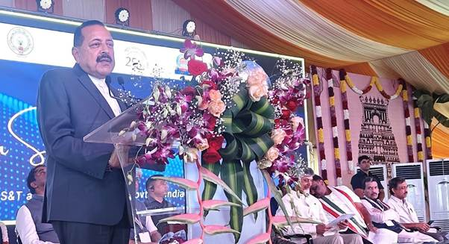
New Delhi, Dec 26 (IANS) India has transformed into a global science and technology leader over the last decade, and the country now sets global benchmarks in space, defence, healthcare, and innovation, said Jitendra Singh, Union Minister of State (Independent Charge) for Science and Technology, on Friday.
Addressing the inaugural session of the Bharatiya Vigyan Sammelan 2025 at the National Sanskrit University here, Singh attributed the feat to “decisive policy support from the top political hierarchy”.
“Over the last decade, science, technology, and innovation have received unprecedented policy focus and budgetary support since 2014, removing long-standing bottlenecks that earlier constrained India’s scientific potential,” the Minister said.
He added that the talent pool in the country was never lacking, but enabling ecosystems and political will were missing, which have now been decisively addressed.
The MoS also highlighted India’s rapid innovation growth in startups — from around 300-400 in 2014 to nearly 200,000 — and Global Innovation Index ranking — from 81 to 38.
India’s strength in space and strategic technologies was visible in the country’s lunar missions, which provided the first confirmed evidence of water on the Moon and achieved the world’s first landing near the lunar south pole.
The growing strength of India’s indigenous defence manufacturing ecosystem can be seen with defence exports reaching Rs 23,662 crore, with Indian-made systems being supplied to nearly 100 countries, Singh said.
“India’s indigenous missile and defence technologies have demonstrated their credibility and reliability, leading to growing international demand,” Singh said.
He underlined that these capabilities are the result of sustained investments in atomic energy, space, and advanced research over the past decade.
Further, on healthcare, the MoS stated India has emerged as a global leader in preventive healthcare and affordable medical solutions.
“From developing and sharing Covid-19 vaccines with the world to exporting medical devices and implants worth billions of dollars annually, India’s healthcare innovation ecosystem has gained international trust and recognition,” he noted, while also highlighting India’s growing impact in scientific research and publications.
Singh emphasised that science in India is no longer confined to laboratories but is being used to enhance ease of living through initiatives such as smart cities, telemedicine, satellite-based communication, geotagging, and digital governance platforms.
Major national missions, including space, nuclear energy, deep ocean exploration, Himalayan research, and the Aroma Mission, are opening new frontiers for economic growth and youth entrepreneurship, he noted.
–IANS
rvt/