



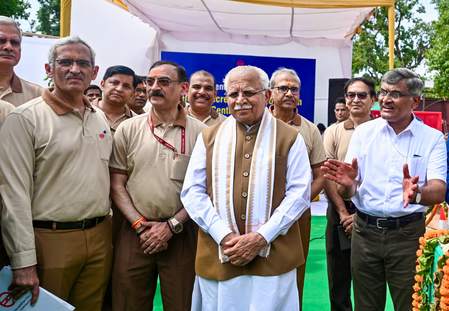
Vadodara, June 29 (IANS) India is preparing to build power generation capacity of 300 gigawatts next year to meet rapidly rising electricity demand driven by data centres, electric vehicles and artificial intelligence, Union Housing, Urban Affairs and Power Minister Manohar Lal Khattar said on Monday.
Addressing the inaugural session of the Vibrant Gujarat Regional Conference (VGRC) for Central Gujarat in Vadodara, the minister said the Centre had planned ahead to ensure that the country’s growing energy requirements did not become a constraint on economic growth.
“Reliable power is one of the strongest foundations of a robust economy. Across the country, we are working to ensure a reliable power supply, and Gujarat has made a major contribution to this effort,” he said.
The minister said that every major sector of the economy, including industries, MSMEs, data centres, metro rail systems, hospitals, and emerging technologies, depends on a reliable electricity network.
Highlighting the sharp increase in demand this summer, Manohar Lal said India recorded its highest-ever peak electricity demand since Independence.
“As summers have become increasingly intense this year, India recorded its highest-ever peak electricity demand. Peak power demand across the country reached about 271 gigawatts, and we successfully met it. Not only that, we had prepared capacity of up to 284 gigawatts to ensure that there would be no shortage,” he said.
He added that electricity demand was expected to continue rising as India’s digital economy and clean mobility ecosystem expanded.
“Over the coming years, we estimate that electricity demand will increase by another 30 gigawatts because of data centres, electric vehicles and artificial intelligence. Accordingly, we have already prepared for a capacity of 300 gigawatts for next year,” the minister said.
Describing the achievement as the result of long-term planning rather than a short-term response, Khattar credited reforms undertaken under Prime Minister Narendra Modi’s leadership over the past 12 years.
“This is not merely a technical achievement. It is the outcome of years of planning, investment and reforms undertaken over the past 12 years under the leadership of Prime Minister Narendra Modi,” he said.
The minister said India’s electricity sector had undergone a significant transformation since 2014.
“If we compare the figures, in 2014 India’s electricity demand stood at around 136 gigawatts, and even that demand could not be fully met. Today, demand has doubled, yet India is reliably meeting the energy requirements of one of the world’s fastest-growing economies,” he said.
According to the minister, India’s installed power generation capacity has increased from 249 gigawatts in 2014 to 542 gigawatts today, enabling the country to meet growing demand while supporting industrial expansion.
He said the government’s reforms had also focused on expanding access to electricity.
Under the ‘Saubhagya Scheme’, nearly three crore households had received electricity connections over the past few years, while the ‘PM Surya Ghar Muft Bijli Yojana’ was further expanding access through rooftop solar power.
The minister added that India was strengthening the electricity network through the principle of “One Nation, One Grid, One Frequency”, enabling greater integration of power generation and transmission across the country.
Turning to Gujarat, Manohar Lal described the state as a national leader in the power sector. “Being a power-surplus state, Gujarat is also leading the country in renewable energy. More than 50 gigawatts of renewable energy capacity has already been installed in the state,” he said.
He said Gujarat had demonstrated that industrial growth and environmental sustainability could progress simultaneously, citing the state’s renewable energy projects and industrial ecosystem.
“From the vast Renewable Energy Park in Kutch to the state’s industrial regions, Gujarat has demonstrated that economic growth and environmental protection can progress together,” he said.
The minister also highlighted Gujarat’s role in the National Green Hydrogen Mission, saying the state was taking the lead in developing renewable energy capacity, transmission infrastructure and the industrial ecosystem required to support green hydrogen production.
“At a time when the entire world is moving towards low-carbon manufacturing, Gujarat is rapidly emerging as one of the world’s most competitive green manufacturing hubs,” he said.
Manohar Lal said reliable electricity, stable policies and modern infrastructure together create the confidence investors require before establishing industries.
“The beginning of an industry does not take place when the first machine is installed. It begins much earlier, when an entrepreneur is assured that a favourable environment exists… where electricity will be reliably available, modern infrastructure and better logistics are in place,” he said.
He said such investments in the power sector would continue to support India’s ambition of becoming a developed nation by 2047 while strengthening Gujarat’s position as one of the country’s leading industrial and manufacturing destinations.
–IANS
mys/dan