



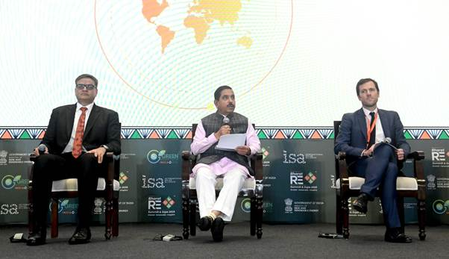
New Delhi, Nov 3 (IANS) Union Minister for New and Renewable Energy Pralhad Joshi on Tuesday reaffirmed India’s commitment towards advancing international solar cooperation and equitable distribution of benefits of progress.
After attending Bharat Renewable Energy Summit and Expo 2026, the minister highlighted that India has been elected President of International Solar Alliance (ISA) for the third consecutive term.
The discussions at the event would reinforce a clear priority of moving from solar commitments to investments, from partnerships to projects, and from ambition to impact, the minister said.
Solar deployment should be financed in areas of most importance, he said, adding that the $200 million Africa Solar Facility represented an important step towards unlocking investment in Africa’s distributed renewable energy sector, Joshi said.
India’s commitment of around Rs 225 crore to the initiative proved its resolve to make affordable solar energy accessible to underserved communities. He further highlighted that the $300 million Nigeria Distributed Renewable Energy Fund offered a model for scaling this approach across the continent.
India remained steadfast in its commitment to advancing international solar cooperation, guided by the vision of ‘Power to Empower and the principle of One Sun, One World, One Grid,’ the minister added.
The vision had brought India and France together to establish the International Solar Alliance in 2015, and currently it has evolved into a powerful platform for international cooperation, particularly for the Global South with 130 ISA signatory and member countries.
ISA-supported initiatives in Fiji, Madagascar, Comoros and Seychelles demonstrated how solar energy could strengthen livelihoods and climate resilience by powering healthcare facilities and schools, providing clean drinking water and supporting agricultural cold storage.
The minister also highlighted empowerment of 3 million farmers in India through solar energy. India’s PM-KUSUM initiative demonstrated how solar-powered agriculture could reduce irrigation costs and create additional income opportunities. ISA works to adapt this model across member countries, particularly in Africa, placing farmers at the centre of the energy transition.
Joshi highlighted the establishment of 17 Solar Technology Application Resource Centres, the Global Capability Centre–SHINE (Strategic Hub for Innovation and Execution) and the AI-enabled ISA Academy. He stated that the focus was on strengthening institutions, developing skills and harnessing emerging technologies to accelerate solar deployment.
—IANS
aar/pk