



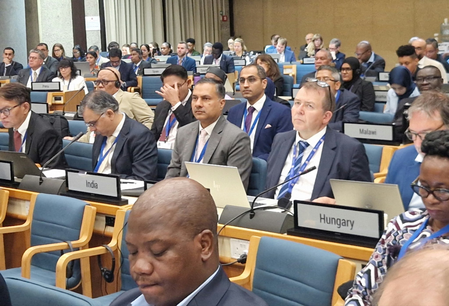
Nairobi, June 30 (IANS) India’s Permanent Representative to the United Nations Environment Programme (UNEP), Adarsh Swaika, on Tuesday led the country’s delegation at the Informal Heads of Delegations (HODs) meeting in Nairobi ahead of the next session of the Intergovernmental Negotiating Committee to develop the instrument on plastic pollution.
“He underlined several key principles on behalf of Indian delegation while conveying India’s readiness to engage constructively towards a balanced and effective outcome,” the High Commission of India in Nairobi wrote on X.
The key principles include “Decisions must be taken by consensus to ensure collective ownership,” and Scope must focus strictly on plastic pollution in line with United Nations Environment Assembly (UNEA) resolution 5/14, avoiding overlap with other international frameworks, particularly with WTO/WHO.
Swaika, also India’s High Commissioner to Kenya, underlined that the process must be member-driven and suggested no capping or regulating the production of primary polymer production to safeguard right to development.
He emphasised that implementation must be country-driven, taking into account national circumstances and guided by Rio principles, including common but differentiated responsibilities.
The Indian High Commission also highlighted that provision of means of implementation to developing countries is critical, including a dedicated multilateral fund and a fair, transparent, inclusive process that is reflective of national circumstances and capabilities.
Recently, Prime Minister Narendra Modi also shared his views on fairness and equity in climate justice during his special address at the National Assembly of Seychelles as part of his official visit to the archipelagic island.
According to PM Modi, the Global South and the island nations are the most impacted by climate change, and the effects are already visible on coastlines, marine ecosystems, weather patterns, and in communities.
“We both firmly believe that those who have contributed the least to climate change should not bear the greatest burden of its consequences. Climate action must be guided by fairness, responsibility, and equity. This is the essence of climate justice,” he stressed.
“India has sought to lead by example. Over the last decade, we have undertaken one of the world’s largest expansions of renewable energy. We have championed sustainable lifestyles through Mission LiFE (Lifestyle for Environment). Through our initiatives, like the International Solar Alliance (ISA), the Coalition for Disaster-Resilient Infrastructure (CDRI), the Global Biofuel Alliance (GBA), and ‘Ek Ped Maa Kee Naam’ (a tree in mother’s remembrance), we have worked with partner countries to boost the green transition,” he noted.
–IANS
ksk/as