



Washington, May 30 (IANS) After nearly eight years of research and planning, the team behind the proposed India Heritage Center is preparing to launch an ambitious effort to create a permanent museum in the American Capital, dedicated to telling India’s story from ancient civilisation to modern nationhood.
The project, led by Indian-American educationist and community leader Dr Amitabh Sharma, aims to establish what organisers describe as the first dedicated museum in the United States focused on India’s civilisational, cultural and historical journey spanning more than 11,000 years.
The proposed institution would use immersive technology, virtual reality, interactive exhibits and multimedia displays to present India’s contributions, challenges and evolution to a global audience.
“Indian history and Indian civilization has never been portrayed in the strength that it deserves,” Sharma told IANS. “It is important in today’s perspective, more importantly, to be able to tell the world that this is the rich civilization, rich heritage that we have in terms of culture, history, our contributions, and so on and so forth.”
Atlanta-based Sharma said the idea emerged from a long-held belief that India’s civilisational story has often been viewed through external lenses and presented in fragmented ways. The objective, he said, is to create a permanent institution that can present a comprehensive and enduring narrative of India’s past, present and future.
“So I think it is time that we told our story and are told, telling our story in a very compelling narrative,” he said.
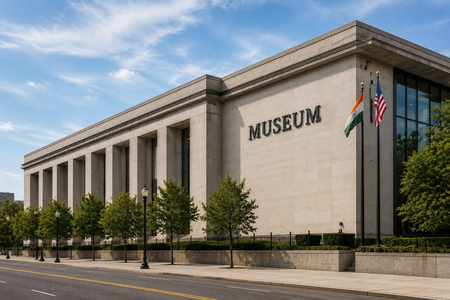
The museum is envisioned as a 20,000-square-foot complex featuring ten galleries, a 350-seat auditorium, a library, reception facilities and a gift centre. Organisers plan to use state-of-the-art technologies, including immersive experiences, interactive audio-video systems, virtual reality, augmented reality, murals and artefacts to engage visitors.
“Well this is a museum of Indian history culture and civilization going back all these years. So 9,500 BC onwards, we have tracked down, there will be 10 galleries in the museum,” Sharma said.
According to project documents, the galleries would guide visitors through India’s civilisational heritage, scientific and technological achievements, spiritual traditions, cultural accomplishments, periods of adversity and the country’s emergence as a modern democratic nation.
Proposed exhibits include sections on the Indus Valley civilisation, Vedic traditions, innovation and scientific discovery, yoga and Ayurveda, cultural heritage, independence movements and modern India’s economic and technological rise.
Sharma said the museum would serve not only the Indian diaspora but also mainstream Americans and other ethnic communities who may have limited exposure to India’s long history and diverse cultural traditions.
“The actual history has not been portrayed,” he said. “So we felt that it is time that we collected all this data, and then we showcased this to not only our community, our diaspora, our future generations who are totally oblivious of the facts, actual facts of the history, but also to sensitize the multiethnic community.”
He said the centre would emphasise India’s traditions of inclusiveness and coexistence.
“We want to tell the world, listen, we have embraced persecuted communities,” Sharma said. “This is a community or a civilization that will always cherish peace and coexistence.”
Washington remains the preferred location because of its visibility and international reach. Sharma said the organisation has already begun efforts to identify a suitable site in the US capital.
“We want this to be in the natural footfall of the people who are visiting,” he said. “First priority is Washington DC and we have already embarked upon a very aggressive, interactive campaign to be able to identify a good location in Washington DC.”
Sharma said the team spent years gathering and validating historical material to ensure accuracy and credibility before moving forward with fundraising and site selection.
“And then it took us a long time to amalgamate or to collate humongous amount of data over 11,000 years and then to get that data validated so that tomorrow nobody can raise a finger or raise an objection,” he said.
The India Heritage Center is registered as a 501(c)(3) non-profit organisation and estimates the total project cost at between $12 million and $14 million. Organisers hope to raise funds through high-net-worth individuals, corporate sponsorships, grants, crowdfunding and community support. They are also exploring naming opportunities for galleries and facilities as part of their fundraising efforts.
“This is not my project. It is not your project. It is the entire Indian communities project.”
He said community response so far has been encouraging.
“When I reach out to people, people say, yeah, why wasn’t it done earlier?” Sharma said. “People are joining in.”
Summarising the initiative, Sharma said: “Indian history, which has not been told in the right fashion or at best tainted or told in fragments need to be told in totality, in genuineness, in authenticity. And this is a valiant effort towards that direction.”
The proposal comes at a time when the Indian-American community has become one of the most influential immigrant groups in the United States, with growing representation in business, technology, academia, medicine and public service. Community organisations across the country have increasingly focused on preserving cultural identity and educating younger generations about India’s history and heritage.
Washington is home to some of the world’s most visited museums and cultural institutions, many dedicated to documenting the histories and contributions of nations, communities and social movements. If realised, the India Heritage Center would add a permanent Indian civilisational presence to the museum landscape of the US capital, offering visitors a comprehensive introduction to one of the world’s oldest continuous civilisations.
–IANS
lkj/rs