



New Delhi: India has recently concluded deals with New Zealand, South Korea and Russia that are advantageous in headline terms, but signal more about India’s quest for strategic autonomy. They mark a deliberate shift in how New Delhi is deploying trade and defence alignment policies as calibrated levers of strategic autonomy amidst rising global rivalries and uncertainties. The agreements, different in scale and context, indicate a strategic logic: India is widening its economic and security options in a world where any singular dependence has become a strategic vulnerability.
The New Zealand Free Trade Agreement (FTA) might appear to be a relatively minor trade compact. But it provides assured access to a developed market while creating entry points into the wider Oceania region. At the same time, India has retained policy space by shielding politically sensitive sectors such as dairy and agriculture, reflecting a careful balancing of openness and domestic stability.
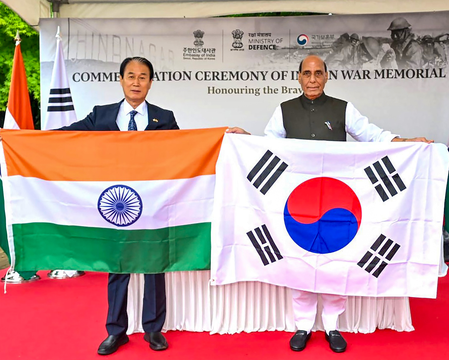
The South Korea agreement operates at a different level of ambition. Here, the objective is not just market access but structural integration into advanced industrial ecosystems. The defence dimensions of India’s engagement with South Korea, and other partners including Russia, reinforces this trend.
India’s continued defence and energy engagement with Russia underscores the persistence of a multi-vector approach.
What links these three deals is not their scale but their intent. India is no longer approaching trade and security agreements as standalone military or economic deals. Instead, they are being layered into a broader architecture of strategic autonomy — one that seeks diversification across partners, sectors, and geographies. India’s deals are increasingly anticipatory, designed to hedge against geopolitical volatility.
Rather than replacing one dependency with another, New Delhi appears intent on distributing its strategic relationships. Trade agreements, in this context, complement defence ties by broadening the economic base of these relationships, making them more resilient and less transactional.
The three deals signal India’s broader push for self-reliance in defence production, but without retreating into isolation. Instead, self-reliance is being pursued through selective integration—absorbing technology, building domestic capacity, and gradually reducing dependence. They also introduce a geopolitical signalling effect. Defence partnerships are rarely neutral. Expanding cooperation with South Korea inevitably intersects with regional dynamics, particularly in relation to China.
The push to upgrade the existing trade framework with Seoul, correct trade imbalances, and expand cooperation in semiconductors, shipbuilding, clean energy and critical minerals signals an attempt to embed India deeper into high-value supply chains. The target of doubling bilateral trade, coupled with institutional mechanisms such as economic security dialogues and industrial cooperation platforms, suggests that trade is being fused with industrial policy and strategic alignment.
The expansion of defence industrial cooperation with Seoul, particularly in artillery systems and advanced manufacturing, represents a shift from simple procurement to co-development and technology transfer. The progression from licensed production of platforms such as self-propelled howitzers to potential joint design of next-generation systems indicates an attempt to build indigenous capability while leveraging external partnerships.
These agreements must be situated within the changing global context. The old certainties of the trading system and national security alignments have eroded. Trade has become entangled with national security, technology control, and geopolitical rivalry. Supply chains are being reconfigured not for efficiency alone but for resilience. Economic relationships are now assessed as much for their strategic implications as for their national security value.
In such an environment, security and trade agreements are tools for managing risk. By entering into multiple overlapping agreements, countries are attempting to reduce reliance on any single partner or axis. This is particularly relevant for India, which must navigate a complex matrix of relationships—maintaining ties with the United States and Europe, managing a competitive coexistence with China, and preserving long-standing linkages with Russia.
The underlying logic is not to choose between rival geopolitical poles but to create optionality across them. Trade agreements become the connective tissue of this strategy with national security implications. They enable access to markets, capital, and technology, while also signalling compatibility with multiple economic and security systems. In this sense, India’s policy is evolving into a form of strategic triangulation, where diversification becomes the core of autonomy.
Yet this strategy has its risks. The expansion of trade agreements can expose domestic sectors to competitive pressures, particularly if safeguards are uneven or poorly implemented. Trade imbalances, as seen in India’s existing arrangement with South Korea, can persist or even widen if structural asymmetries are not addressed. Moreover, deeper integration into global value chains may come with implicit expectations on standards, alignment, or policy choices that could constrain autonomy over time.
Even so, the strategic direction is clear. India’s trade and defence alignment policies are being recast from defensive postures into strategic instruments. The agreements with New Zealand, South Korea and Russia are not endpoints but indicators of a larger global shift in a fragmenting and uncertain global order, and India’s quest to maintain autonomy therein.
(Vivek Y. Kelkar is a researcher and analyst whose work explores global power shifts, strategy, trade transitions, and the geopolitics of systemic risk. Views expressed are personal)