



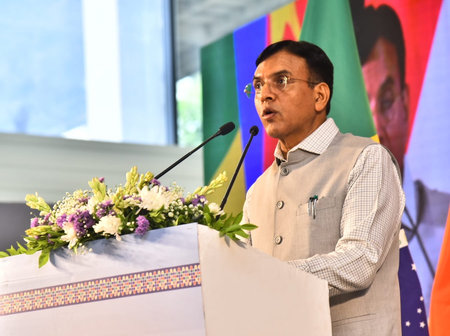
Hyderabad, July 14 (IANS) Union Minister for Labour and Employment, Mansukh Mandaviya, on Tuesday inaugurated the 15th BRICS Trade Union Forum (TUF) Summit 2026 here, calling for building a worker-centric global order where technological advancement is guided by social justice, responsible innovation and human dignity.
Addressing delegates from BRICS countries at the inaugural session, the Union Minister said that India’s BRICS Presidency theme, “Building for Resilience, Innovation, Cooperation and Sustainability”, reflects the country’s commitment to ensuring that the future of work remains inclusive, equitable and centred on the welfare of workers.
Union Minister Mandaviya highlighted that India’s social protection coverage has increased from 19 per cent in 2015 to 64.3 per cent of the total population in 2025, covering nearly 940 million people, while preliminary estimates for 2026 indicate that the coverage has crossed one billion citizens.
On employment generation, the Union Minister said that nearly 170 million employment opportunities have been created in the last decade.
He added that the Pradhan Mantri Viksit Bharat Rozgar Yojana aims to create 35 million formal sector jobs over the next two years through employment-linked incentives.
Union Minister Mandaviya said that trade unions have played an important role in safeguarding workers’ rights, strengthening industrial harmony and ensuring that economic progress is accompanied by social justice.
He added that India remains committed to the vision of “Sabka Saath, Sabka Vikas” under the leadership of Prime Minister Narendra Modi, where economic growth and workers’ welfare are complementary pillars of sustainable development.
Highlighting the Union government’s labour reforms, the Union Minister said the Four Labour Codes have consolidated 29 labour laws into a simplified framework while strengthening workers’ rights.
The reforms provide for universal minimum wages, appointment letters, improved occupational safety and health, digital compliance systems and, for the first time, formal recognition of gig and platform workers.
Union Minister Mandaviya said that India has leveraged digital public infrastructure to transform labour governance.
He told that the e-Shram portal has registered more than 317 million unorganised workers, enabling them to access various welfare schemes, while the National Career Service Portal connects job seekers, employers, career centres and training providers through a nationwide digital employment platform.
Referring to India’s social security architecture, the Union Minister said the Employees’ Provident Fund Organisation (EPFO), with more than 80 million active members and eight million pensioners, is among the world’s largest social security organisations.
The Employees’ State Insurance Corporation (ESIC) provides healthcare and social security benefits to more than 150 million insured persons and their dependants.
He added that continuous reforms in EPFO and ESIC have expanded coverage, simplified procedures and improved service delivery.
Union Minister Mandaviya noted that the BRICS countries together represent nearly half of humanity and one of the world’s largest labour forces.
He said there is considerable scope for enhanced cooperation in areas such as social security, labour mobility, skill development, AI governance and decent work, and expressed confidence that the recommendations emerging from the forum would contribute to the forthcoming BRICS Labour and Employment Ministers’ Meeting.
Representatives from BRICS countries, including Carlos Augusto Muller (Brazil); Sergei Chernogaev, Federation of Independent Trade Unions of Russia (FNPR) Chairman; Huxiang Zhu (China); Masale Godfrey Selematsela (South Africa); Yuki Otsuji, Workers’ Specialist at ILO-New Delhi, and Justice (Retd.) N. Nagaresh, participated in the inaugural session.
Organised by the Bharatiya Mazdoor Sangh (BMS), the three-day summit has brought together more than 50 international delegates and around 70 representatives of Indian trade unions, labour experts and academicians.
Deliberations over the next two days will focus on four thematic areas: universal social security and portability of benefits, human-centric technology and responsible AI, skill development for the future of work, and women in the changing world of work.
–IANS
sps/khz