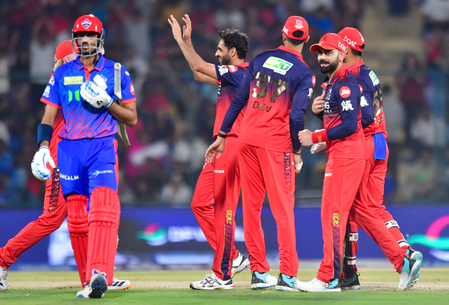
New Delhi, April 28 (IANS) Four overs, 23 deliveries, eight runs and six wickets – the result of the clash between Delhi Capitals and Royal Challengers Bengaluru was very much decided before a majority of the crowd, after completing their work shifts, took their seats at the Arun Jaitley Stadium.
The Kotla crowd on Monday had come for just one guy; Virat Kohli. RCB’s team bus drew louder cheers than Delhi’s own – a small but pointed reminder of who this fixture really belongs to. The fans sporting ‘Kohli, 18’ jersey had their money’s worth when the talismanic batter duly finished off the chase in seven overs.
But what lingered as fans came out of the stadium much earlier than expected ending time was something they had not bargained for – a powerplay so dominated by accurate Test match lengths, swing and bounce.
The chatter was not much about the joy of seeing Kohli reach Mount 9000 runs in IPL, but whether they had somehow wandered into a Test match in England via Bhuvneshwar, the newest joint wicket taker in the competition, and Hazlewood, who got his fourth scalp with a pin-point yorker to castle Abishek Porel.
In a tournament that has spent recent weeks redefining the limits of batting – DC themselves posted 264 in their previous outing – and talking about the lack of bat and ball balance, the proceedings of Monday night in New Delhi felt like a gentle course correction. The venue which saw batters make 5329 runs on pitch number six Saturday offered something different under the floodlights via pitch number five on Monday: swing, seam, impeccable lengths and unpredictable bounce.
Hazlewood, operating with the economy of a man who wastes nothing, became the tormentor in chief alongside Bhuvneshwar, who laid the foundation for the carnage. A swinging delivery angled away outside off drew an outside edge from debutant Sahil Parakh that fell short of third man.
Bhuvneshwar noticed what he needed to notice: the highly-talked left-handed batter would not move his feet, and surely not resist a delivery shaped to look hittable. The next ball from Bhuvneshwar, who consistently got two to four degrees of swing, was fuller, angling in and came in late to castle Parakh for a duck.
KL Rahul arrived carrying fresh momentum from his 152 not out against the Punjab Kings. He is the only batter in the competition’s history to have scored more than a hundred runs against Hazlewood, and had scored boundaries off him early on when DC had upstaged RCB at the M Chinnaswamy Stadium.
Hazlewood’s response was to go short, early, and with pace. The ball rose hard into Rahul’s body and the pull shot, though instinctive, took a top-edge and Jitesh Sharma settled beneath it well to end Rahul’s stay.
Sameer Rizvi, lured by a full ball in the channel outside off stump, edged behind while attempting a drive while Tristan Stubbs fended a late-swinging delivery to first slip. DC captain Axar Patel, trying to exercise the discipline his colleagues had abandoned, left the first delivery well enough.
But then Bhuvneshwar switched angles, going around the wicket and found his bottom edge, which was safely pouched by the keeper. Hazlewood’s bounce would create problems for Nitish Rana, who was in an ugly tangle against the short ball and gave a catch to gully.
By the time power-play ended, before a feeble dust storm came into the picture, DC’s score read as 13/6, the lowest powerplay score in the competition’s 19-year history. The numbers exist, but they risk obscuring what was actually happening at the crease: two experienced bowlers at their menacing best making and executing decisions four or five steps ahead of the batters facing them.
Each dismissal had a logic that became visible only in retrospect, leading to more glee for RCB. “It was unbelievable. Again, world-class bowlers. You are talking about Bhuvneshwar Kumar and Josh Hazlewood. Seeing them operate from both the ends, they were bowling 18 balls each in powerplay. We talk a lot in the league, that batsmen are making 200-250 runs and they are hitting sixes and fours everywhere.
“Suddenly, a match comes where you see two world-class bowlers bowling and doing their thing, where the wicket was not that bad. But it was pure out-and-out, their skill set. For so many years, why they are one of the best bowlers in the world going around, they showed that by bowling 18-18 balls.
“So, it was quite pleasing to see. I mean, to get six wickets in powerplay, which is almost literally, you have taken the game away from the opponent. So, it was quite fun out there and we are lucky to have them there in our team,” said RCB left-arm spin bowling all-rounder Krunal Pandya, while replying to a question from IANS, in the post-match press conference.
The larger question is whether Monday’s events represent an anomaly or an argument. T20 cricket has accelerated relentlessly in recent years, with ground dimensions, batting techniques and rule changes all tilting the contest toward batters. Scores above 200 have become routine. Bowling attacks are increasingly managed and pencilled to limit damage rather than take wickets.
But for the first 30 minutes at the Kotla, two practitioners of the good old Test match virtues made that entire batting heavy framework look provisional. The conditions gave them something, and they were good enough to know exactly what to do with it. Axar, who looked baffled and shell shocked at the same time, could only give kudos to Bhuvneshwar and Hazlewood for rattling DC, who looked like a deer caught between headlights and bring them cruelly down to Earth after ransacking 264 took them to cloud nine in batting.
“No, seriously, I feel that, just two days ago, there was a match, and that wicket, and this wicket also, it felt similar and everything was there. So I think, back of the mind, batters felt that there will be similar bounce and conditions. But the wind was also blowing, and that was a day match, and this was a night match, so because of that, I felt that that swing moment was more.
“At the same time, I think Bhuvi and Hazlewood are world-class bowlers. That swing, I think, in the first two overs, they are used to getting it done, irrespective of the wicket, or ground. But the way they were getting it, they did a good job and they bowled well.
“The batters, I feel that in the last match, they were in momentum and felt it will be good to feel the ball on the bat again. In that, they got one or two outs. After that, under pressure, I think, whoever went suddenly got a shock that, ‘No, this just happened.’
“So I think, for that, as a professional, they should be prepared. But, yes, that happened. In the last match, the momentum, batters felt that they will play a good wicket. But we will give credit to them that they also bowled very good balls,” he added.
In a format tilting heavily towards batters, where totals above 200 have become normal and bowlers are managed to limit damage rather than inflict it, Monday night felt like a rare recalibration which is worth celebrating.
Conditions and craft still matters to excel in T20 cricket and Bhuvneshwar and Hazlewood showed bowlers that they can still make this format feel, briefly and gloriously, like their own and enjoy it, just like how they did on a manic Monday evening in New Delhi.
–IANS
nr/bc