



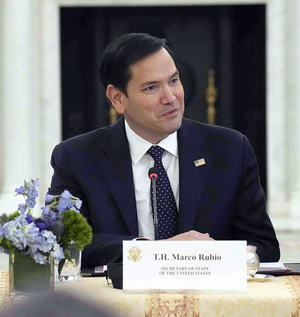
Washington, April 27 (IANS) US Secretary of State Marco Rubio Monday said internal divisions within Iran’s leadership remain the biggest obstacle to any agreement with Washington, even as he indicated Tehran may be under growing pressure to strike a deal.
In an interview with Fox News’ Trey Yingst on Monday, Rubio described Iran’s power structure as deeply fragmented, complicating negotiations and limiting what its officials can commit to at the table.
“Other than the fact that the country is run by radical Shia clerics, that’s a pretty big impediment. The other is that they’re deeply fractured internally, and I think that’s always been the case, but I think it’s far more pronounced now,” Rubio said.
He dismissed the notion of meaningful ideological divides within Iran’s leadership, arguing that all factions share a hardline outlook, though they differ in priorities.
“The best way to understand Iran is to have a political class now. I think, look, people talk about moderates and hardliners. They’re all hardliners in Iran. But there are hardliners who understand they have to run a country and an economy, and there are hardliners that are completely motivated by theology,” Rubio said.
Rubio explained that this divide plays out between those who manage state functions and those driven by ideological goals, creating persistent tension within the system.
“The hardliners that are motivated by theology are not just the IRGC officials, but obviously the supreme leader and the council that surrounds him. And then you’ve got the political class, the foreign minister, the president, the speaker of the moguls. These guys, they’re hardliners, too, but they also understand the country has to have an economy,” he said.
“And so you see a tension… between the Iranians who understand, let’s be hardliners. But let’s also balance that with the need to run a country and the hardliners who don’t care and have this apocalyptic vision of the future,” he added.
According to Rubio, this imbalance ultimately tilts decision-making power towards the more ideologically driven factions.
“Unfortunately, the hardliners with an apocalyptic vision of the future have the ultimate power in that country,” he said.
He stressed that this internal dynamic complicates US diplomacy, as Iranian negotiators themselves must navigate competing centres of authority before making commitments.
“So as much as anything else, one of the impediments here is that our negotiators aren’t just negotiating with Iranians. Those Iranians then have to negotiate with other Iranians in order to figure out what they can agree to, what they can offer, what they’re willing to do, even who they’re willing to meet with,” Rubio said.
At the same time, Rubio signalled that economic pressures may be pushing Tehran towards engagement. “I think they are serious about getting themselves out of the mess that they’re in,” he said, citing worsening economic conditions.
“Price inflation is worse… They still have trouble making payroll. Their economy has flattened, and they face crippling economic sanctions around the world. All those problems are there, and many of them are worse,” he added.
His remarks come amid reports that Iran has proposed reopening the Strait of Hormuz in exchange for the United States ending its blockade on Iranian ports, though the offer does not include concessions on its nuclear programme.
–IANS
lkj/dan