



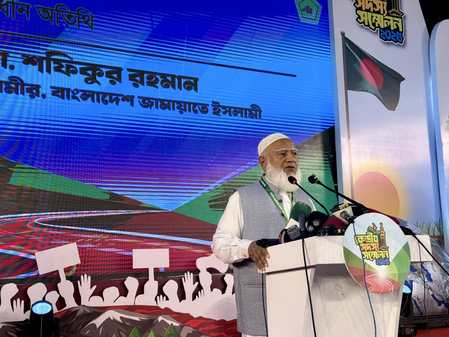
Dhaka, Feb 3 (IANS) Bangladesh Jamaat-e-Islami leader Shafiqur Rahman’s recent social media remarks equating women’s work outside the home with prostitution are not merely a conservative stance but dehumanising, reducing teachers, garment workers, doctors, nurses, journalists, police officers and civil servants to a single degrading label, a report said on Tuesday.
According to a report in ‘Time of Bangladesh’, in a country where women are from the numerical majority rather than a marginal minority, such language inevitably comes across as an attack on mothers, daughters, sisters and grandmothers alike. The outrage that followed was not manufactured, but a “visceral response” from people whose lives and the lives of women they depend on — were dismissed as “morally corrupt”.
The report highlighted that Jamaat’s insistence that women should never assume leadership because “Allah did not permit this,” coupled with the claim that women’s participation in public life represents decay or even “another form of prostitution,” struck a deep chord because it exposed the party’s attitude towards more than half of the country’s population.
“The party’s insistence that the post was the result of hacking does little to address the deeper issue. The outrage did not arise simply because of one offensive word or one badly timed post. It arose because the ideas expressed in that post closely mirror positions Shafiqur Rahman has already articulated publicly, including in a recent interview with Al Jazeera where he categorically ruled out women leading his party or the state,” the report detailed.
“Senior Jamaat leaders openly defended those remarks at the time. The only substantive difference between the interview and the X post is linguistic: the interview did not contain the term ‘prostitution,’ while the post used it explicitly. That choice of word is what transformed a familiar ideological stance into a national flashpoint,” it added.
Emphasising the far–reaching political implications, the report said Jamaat’s pursuit of electoral legitimacy and eventual state power raises an unavoidable question about whether women can be safe, socially and politically, under a party that views their presence in public life as inherently immoral.
It stressed that in Bangladesh, where the social welfare system is limited, and millions of families survive on women’s work — often as the sole or primary breadwinners — Jamaat’s position appears especially stark.
“From garment factories to rural clinics, from classrooms to overseas labour markets, women’s earnings keep households afloat. If Shafiqur Rahman’s vision were implemented in practice, the consequences would be devastating. Families would lose income, children would be pushed deeper into poverty, and the already fragile social safety net would tear further. Moral rhetoric offers no answer to the practical question of who would feed these families,” the report noted
–IANS
scor/as