



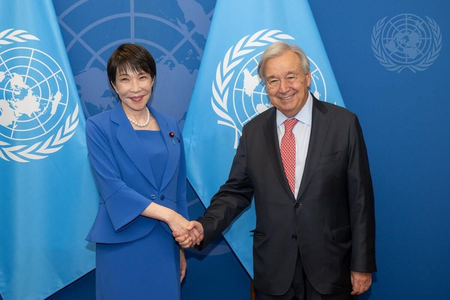
United Nations, Sep 23 (IANS) Japanese Prime Minister Sanae Takaichi raised reform of the United Nations Security Council during a meeting with UN Secretary-General Antonio Guterres, giving fresh prominence to an issue closely watched by India.
The meeting took place at UN headquarters during the high-level week of the 81st session of the General Assembly.
“The Secretary-General and the Prime Minister also discussed Security Council reform, as well as regional and global issues,” the UN said in an official readout.
The brief statement did not identify any specific reform proposal discussed by Takaichi and Guterres. It also did not say whether they addressed the expansion of permanent or non-permanent membership.
Guterres expressed appreciation for Japan’s longstanding contributions to the United Nations and its support for multilateralism, according to the readout.
Japan has been one of the leading advocates of expanding the Security Council to reflect present-day political, economic and demographic realities.
The issue has particular relevance for India because New Delhi and Tokyo are members of the Group of Four, or G4, alongside Brazil and Germany.
The four countries support each other’s campaigns for permanent seats on an expanded Security Council. They also favour greater representation for Africa and other underrepresented regions.
The Takaichi-Guterres discussion came as world leaders gathered in New York for the annual General Assembly debate.
In his opening address, Guterres said global institutions continued to reflect power arrangements from eight decades ago rather than current international realities.
He called for a multilateral system centred on the United Nations that was more balanced and representative.
The Japanese prime minister’s discussion with Guterres added a bilateral dimension to the wider debate over whether the UN’s most powerful decision-making body can remain credible without structural reform.
The UN readout did not indicate whether Takaichi sought a timetable for negotiations or changes to the Council’s veto system.
It also provided no details about the other regional and international matters discussed during the meeting.
Security Council reform has remained stalled despite broad acknowledgement among UN members that representation needs to be widened.
Differences persist over the number of new seats, whether they should be permanent, which countries or regions should occupy them and whether any new permanent members should receive veto power.
The Security Council has 15 members. China, France, Russia, the United Kingdom and the United States are permanent members with veto power. The General Assembly elects the other 10 members for two-year terms.
India argues that its population, economic scale, contribution to UN peacekeeping and role in international affairs support its claim to permanent membership. New Delhi has also said the absence of permanent representation for Africa, Latin America and large parts of Asia weakens the Council’s legitimacy.
India, Japan, Brazil and Germany formally coordinate their reform campaign through the G4. Changing the UN Charter requires approval by two-thirds of the General Assembly and ratification by two-thirds of UN members, including all five existing permanent Security Council members. That threshold has made structural reform politically difficult despite decades of negotiations.
–IANS
lkj/rs