




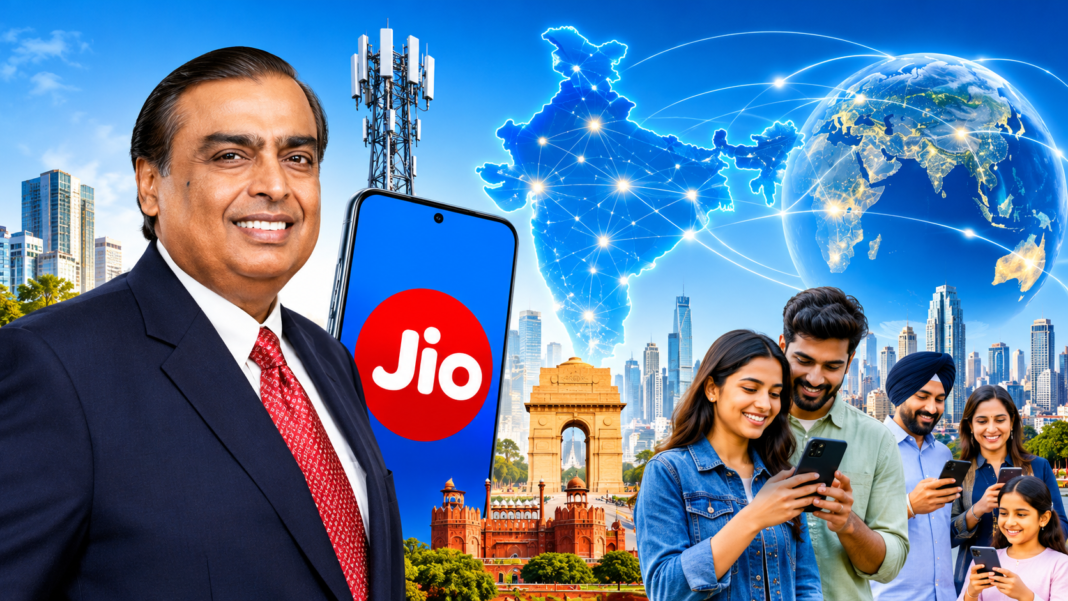
For Indians abroad, Jio is more than a telecom brand—it is the thread that keeps us connected to home. A decade ago, a gigabyte of mobile data cost ₹200–300 and internet access was largely an urban privilege. Jio’s 2016 launch changed that story decisively, bringing data costs down to roughly ₹10 per GB and triggering one of the fastest mass digital adoptions anywhere in the world. For the diaspora, that shift meant clearer video calls with ageing parents, easier remittance-linked payments, and a homeland that felt closer than ever.
The democratisation angle is Jio’s most powerful legacy. Cheap data allowed small businesses in tier-2 and tier-3 towns to accept UPI payments, list products online, and reach customers beyond their streets. Students in remote districts could access online lectures and skill courses that were once available only in metros. Farmers could check mandi prices; artisans could sell through digital storefronts; families could use telemedicine and e-governance services from their phones. For Non-Resident Indians, this inclusive digital base has made it easier to support family businesses, mentor young entrepreneurs, and participate in India’s growth from anywhere in the world.
Jio’s evolution into a broader tech ecosystem adds another positive layer. With over 500 million subscribers, Jio Platforms has expanded into streaming through JioCinema, retail through JioMart, financial services through Jio Financial Services, and fiber connectivity for homes. For the diaspora, this means one integrated digital space for entertainment, shopping, banking, and staying in touch with Indian culture and commerce. A grandparent in Kerala can stream a regional film; a cousin in Gujarat can run a small online store; an NRI in Australia can manage family payments and investments with greater ease. That convenience is not merely commercial—it is a form of everyday connection.
The “data as oil” narrative can also be viewed constructively. India’s vast data infrastructure, built on affordable access, fuels innovation in fintech, agritech, edtech, and healthtech. It creates opportunities for Indian startups to scale and for global Indian professionals to collaborate with the homeland. With privacy-by-design, transparent consent, and responsible innovation, this data ecosystem can build trust while delivering inclusion. The goal is not simply to collect data, but to use it to solve real problems—financial inclusion, education access, healthcare reach, and small-business growth.
For Indians abroad, Jio’s story is a reminder of what scale and affordability can achieve. It has made India one of the world’s most digitally connected nations and given millions their first meaningful access to the internet. The next chapter is about deepening that inclusion: connecting schools, clinics, farms, and small enterprises; expanding fiber to every village; and building digital services that are simple, affordable, and useful. Jio proved that access can be democratised. The opportunity now is to ensure that the benefits of that access reach every Indian family—at home and abroad.