



Amman, Oct 10 (IANS) The strategic partnership between India, the United Arab Emirates (UAE) and Israel has demonstrated considerable resilience, with the recent Flydubai terrorist attack further underscoring the importance of cooperation among the three nations. It shows that the infrastructure connecting them is not just about trade, but also sits at the intersection of regional security, political architecture and economic resilience between India, the Gulf and the Mediterranean, a report has stated.
“For Amman, the stakes are even higher. Jordan cannot afford to become simply the territory through which sealed containers travel between Saudi Arabia and the Mediterranean. Its national interest lies in converting geography into dry ports, logistics, industry, employment and investment,” Italian-Indian entrepreneur and analyst, Vas Shenoy, wrote in ‘Caṇakya — The Indo Mediterranean Initiative’.
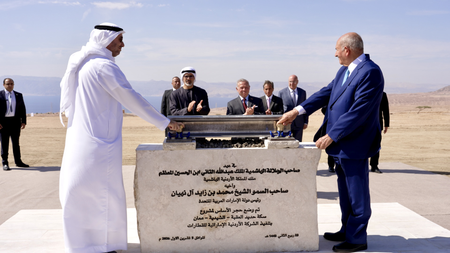
On October 5, Jordan’s King Abdullah II and Abu Dhabi Crown Prince Sheikh Khaled bin Mohamed bin Zayed Al Nahyan laid the foundation stone for the Aqaba-Shidiya-Ma’an railway. While the line is officially intended to transport phosphate and potash to the Red Sea, the project also marks the beginning of something Jordan has lacked for decades — a modern freight rail network that could eventually become a vital component of the India-Middle East-Europe Economic Corridor (IMEC), Shenoy opined.
Since IMEC was announced at the 2023 G20 Summit in New Delhi, maps of the corridor have depicted an almost natural route linking India, the UAE, Saudi Arabia, Jordan, Israel and Europe.
“The maritime connection between India and the UAE already exists. The Emirates have built Etihad Rail. Saudi Arabia has a rapidly expanding railway network. On the Mediterranean side, Israel’s railway reaches Beit She’an, close to the Jordanian border, connecting it to Haifa. In between lies Jordan, without the railway continuity necessary to connect these systems,” he mentioned.
“Amman was not among the signatories of the original IMEC memorandum in 2023. Jordan, however, given its position, is difficult to bypass. The most natural route between the Saudi and Israeli railway networks crosses Jordanian territory. Without that connection, the Middle Eastern railway component of IMEC remains incomplete,” he noted.
According to the expert, the Jordanian-Emirati project would connect Shidiya and Ghor Al-Safi with Aqaba and the proposed Ma’an dry port. He noted that for Amman, however, the project forms part of a wider railway network, with plans for an approximately 418-kilometre line linking Aqaba, Ma’an and Madouneh to the Amman area.
“From there, the network could eventually connect with Saudi Arabia, extend northwards towards Syria and Turkey and, under different political circumstances, move westwards towards the Israeli railway network and the Mediterranean. Ma’an, and particularly Madouneh, therefore become important points not only for IMEC, but for a much broader regional transport architecture,” Shenoy highlighted.
–IANS
scor/ksk/as