



Nairobi, Oct 17 (IANS) Kenya has intensified contact tracing, quarantine measures, screening at airports and border crossings, and infection prevention efforts as the number of Ebola cases in the country rises to three.
Patrick Amoth, director-general for health in Kenya’s Ministry of Health, said that the case of Ebola Bundibugyo virus disease, which was confirmed on Friday, was a 65-year-old woman who was a close relative of the first and second cases, Xinhua News Agency reported.
She had been in quarantine since Oct. 6 and had developed a fever, sore throat and malaise.
“Having been in quarantine, she was diagnosed early and is currently receiving supportive care, improving her chances of recovery while limiting the risk of further spread of the disease,” Amoth said.
To prevent further spread of the disease, Amoth said Kenya had significantly scaled up its surveillance operations, successfully tracing and quarantining 127 of the 130 identified contacts.
“Of the 130 listed contacts, 127 (97.7 per cent) have been traced and placed in quarantine, exceeding the global benchmark of 85 per cent required to break the chain of transmission, while active efforts continue to locate and quarantine the remaining three,” he said.
Amoth said the overall risk in the country remained low, as there was no evidence of community transmission. Contacts in quarantine were being closely monitored to ensure that any new cases could be detected and treated promptly.
On Oct. 12, Kenya declared Ebola a formidable epidemic disease under the Public Health Act, with the government introducing new regulations governing disease surveillance, screening, isolation, quarantine and the management of suspected infections.
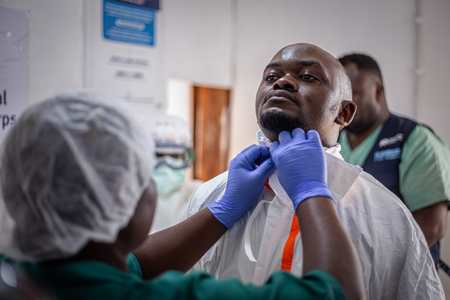
Under the regulations, public health screening must be conducted at major points of entry, suspected cases must undergo medical assessment, and patients must be isolated and referred for treatment. Individuals who may have been exposed to the virus must also be monitored and quarantined.
The regulations also require the designation of health facilities responsible for managing Ebola cases and the establishment of procedures for inspecting and decontaminating premises where infections may have occurred.
Kenya notified the World Health Organisation (WHO) after reporting its first Ebola case, in accordance with the International Health Regulations (2005).
“The two new cases have been detected early because they were already in quarantine and were being checked every day,” said Neema Kimambo, WHO representative to Kenya, on Friday.
She commended the Ministry of Health, the Kenya National Public Health Institute, and national and county health teams for their swift response.
“We thank the health workers, response teams and families in quarantine for their commitment,” she added.
Kenya is the fourth country in the world to confirm Ebola virus disease in the current context, following the Democratic Republic of the Congo (DRC), Uganda and France.
Most Ebola cases in Kenya and Uganda were imported from the DRC, while the case in France was travel-related and reported in June.
According to WHO, the early symptoms of Bundibugyo Ebola can resemble those of malaria and other common illnesses. They include fever, fatigue, muscle or joint pain, headache and sore throat.
There is currently no licensed vaccine or specific treatment for Bundibugyo Ebola, although clinical trials are underway in the DRC, according to WHO.
Kenya’s borders remain open, with no restrictions on travel, trade or public gatherings.
–IANS
ksk/