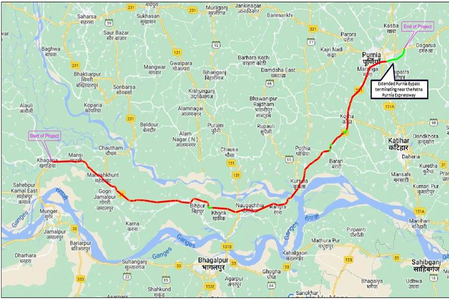
New Delhi, July 19 (IANS) The proposed upgradation of the Khagaria–Purnea section of NH-31 and NH-231 to a four-lane highway by the Ministry of Road Transport and Highways, recently approved by Cabinet Committee on Economic Affairs (CCEA) is poised to propel Bihar’s agricultural heartland on the path to prosperity, according to an government factsheet issued on Sunday.
Before dawn breaks over the fertile plains of Bihar, trucks loaded with bunches of bananas leave the farms of Khagaria, while sacks of makhana begin their journey from ponds and processing centres of Purnea, one of the country’s biggest makhana hubs.
For years, traffic congestion and seasonal disruptions have often slowed the journey of these highly-valued crops. For a crop as perishable as banana, where every hour matters, faster and more reliable connectivity can help minimise spoilage, preserve quality and improve market realisations for farmers.
The upgradation of the Khagaria-Purnea Section of NH-31 and NH-231 to 4-lane standard in Bihar at a cost of Rs 3936.05 crore is more of an investment in the people whose livelihoods depend on getting Bihar’s bananas and makhana to market efficiently, helping strengthen the economic backbone of the state’s agricultural heartland. In a region where a few hours can make a difference to the quality and value of agricultural produce, the upgradation of highways is poised to become more than a transport project.
Eastern Bihar’s transport network has historically been vulnerable to flooding, particularly in areas influenced by the Kosi and Ganga river systems. Seasonal flooding often affects road connectivity, slowing the movement of people and goods and increasing travel uncertainty for local communities.
The four-laning of the Khagaria–Purnea section is expected to incorporate engineering interventions aimed at enhancing the highway’s resilience against recurring flood-related challenges. By improving road geometry, strengthening pavement structures and integrating modern drainage systems, the project is designed to support more reliable transportation throughout the year.
The Seemanchal region has long faced developmental challenges linked to limited connectivity. Districts such as Khagaria, Katihar and neighbouring areas often experience longer travel times to administrative, educational and economic hubs compared to many other parts of the state.
The upgraded corridor holds the potential to significantly improve regional mobility by reducing travel time between key destinations. Journeys that currently take around 3.5 to 4 hours are expected to be completed in approximately 1.5 to 2 hours once the corridor becomes operational.
Beyond its importance for Bihar, the Khagaria–Purnea corridor holds strategic value for interstate connectivity across eastern India.
The upgraded highway will strengthen road links between Bihar and neighbouring West Bengal while improving access to Jharkhand through the broader National Highway network.
The proposed upgradation of the Khagaria-Purnea section of NH-31 and NH-231 addresses longstanding bottlenecks, including insufficient geometric features, sharp curves and congestion through densely populated urban and semi-urban stretches across Khagaria, Bhagalpur, Katihar and Purnia districts. The Khagaria-Purnea project will upgrade the critical two-lane corridor to four lanes, strengthening connectivity across Bihar’s Seemanchal region and linking Khagaria, Bhagalpur, Katihar and Purnea with Patna, West Bengal and Jharkhand.
The upgraded corridor will also strengthen connectivity to several of Bihar’s key economic, social and logistics hubs. By linking five PM Gati Shakti Economic Nodes, including one textile cluster, two mega food parks and two fishing and seafood parks, along with 11 logistics nodes comprising four major railway stations, one airport, four National Highways and two State Highways, the project will significantly enhance multimodal integration across the region.
–IANS
sps/pk