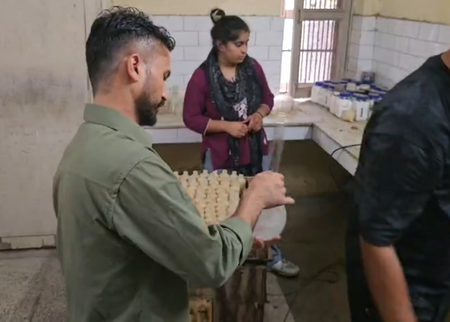
Yamunanagar (Haryana), Sep 2 (IANS) The Soil Health Card scheme, launched by the central government led by Prime Minister Narendra Modi, is helping farmers determine the nutrient status of their fields through soil testing and make informed decisions about fertiliser use.
Officials and soil-testing experts told IANS that the initiative can help reduce unnecessary expenditure on fertilisers while improving soil health and crop productivity.
Soil samples are tested to identify which nutrients are adequately available in the soil and which are deficient. So based on the results, farmers are advised on the type and quantity of fertilisers required for specific crops.
At the Soil Testing Laboratory in Jagadhri, Analytical Associate Yogesh told IANS that 12 parameters are examined during soil testing, including pH, electrical conductivity (EC), organic carbon, nitrogen, phosphorus, sulphur, potassium, zinc, manganese, iron, copper and boron.
“Testing helps farmers understand which nutrients are deficient, adequate or present in excess, allowing them to use fertilisers accordingly,” Yogesh said.
He pointed out that farmers often apply certain fertilisers without knowing whether the corresponding nutrients are already sufficiently available in their soil. Such indiscriminate use not only increases cultivation costs but can also adversely affect soil health.
Yogesh further explained that pH indicates whether the soil is acidic or alkaline, while EC provides an indication of the salt content in the soil. Nitrogen, phosphorus, potassium and sulphur are among the major nutrients required by crops, while zinc, manganese, iron, copper and boron are micronutrients needed in smaller quantities.
According to him, symptoms such as fruit cracking can sometimes be associated with boron deficiency, while yellowing or reddening of leaves may be linked to zinc deficiency. However, soil testing provides a more reliable assessment of nutrient availability than relying solely on visible symptoms.
Once testing is completed, farmers receive information on the nutrient status of their soil along with recommendations on the quantity of fertiliser required per acre for a particular crop. This information is provided through the Soil Health Card.
The Agriculture and Soil Testing Department also conducts awareness camps every year. Department teams visit villages at the block level to educate farmers about soil testing, reducing cultivation costs and maintaining soil health.
Yogesh said soil testing is provided free of cost. Farmers can bring soil samples directly to the laboratory, while under initiatives such as “Har Khet Swasth Khet” (Every Field Healthy Field), agriculture department employees also collect samples from fields and send them to laboratories for testing before providing farmers with Soil Health Cards.
District Agriculture Officer Aditya Dabas said the department receives annual targets for soil testing in Yamunanagar district. Farmers can submit samples themselves, while field-level employees and officers also collect samples from agricultural land.
“The primary objective of soil testing is to assess the health of the field. Continuous cultivation of the same crops and prevailing crop cycles can lead to deficiencies of certain essential nutrients in the soil,” Dabas said.
Yamunanagar is known for the cultivation of crops such as wheat, paddy and sugarcane, while mustard is grown in some areas. Poplar cultivation is also undertaken in the district.
Dabas said farmers traditionally tend to rely on fertilisers such as DAP, urea and zinc. However, soil testing can reveal the status of other nutrients and help determine the actual requirements of a crop.
“This makes it possible to decide how much of which fertiliser should be applied to a particular crop. When farmers know which nutrients are deficient and which are already adequately available, they can use fertilisers in a balanced manner,” he said.
According to Dabas, 1,10,158 soil samples were received in Yamunanagar last year. All the samples were tested in laboratories, and farmers were provided with soil reports in the form of Soil Health Cards.
The cards contain details of the nutrient status of the soil and recommendations on the quantity of manure and fertilisers required according to the crop. Dabas said balanced fertiliser use could reduce unnecessary expenditure while ensuring that crops receive the nutrients they need.
He urged farmers to get their soil tested regularly and make use of the free facility provided by the government. “Knowing the actual condition of the soil enables farmers to make better decisions about fertiliser application. This can help improve both the health of the soil and crop production,” he said.
–IANS
brt/uk