




By Ridhi Arora
It does not announce itself with grandeur. There are no towering skylines, no restless traffic, no urgency that defines arrival. Instead, Lakshadweep unfolds quietly — a chain of islands scattered across the Arabian Sea, where the horizon feels closer and time appears to move differently. For a traveller accustomed to the mainland, the first encounter is not with activity, but with stillness. And in that stillness lies the beginning of understanding.
An archipelago formed by water and time
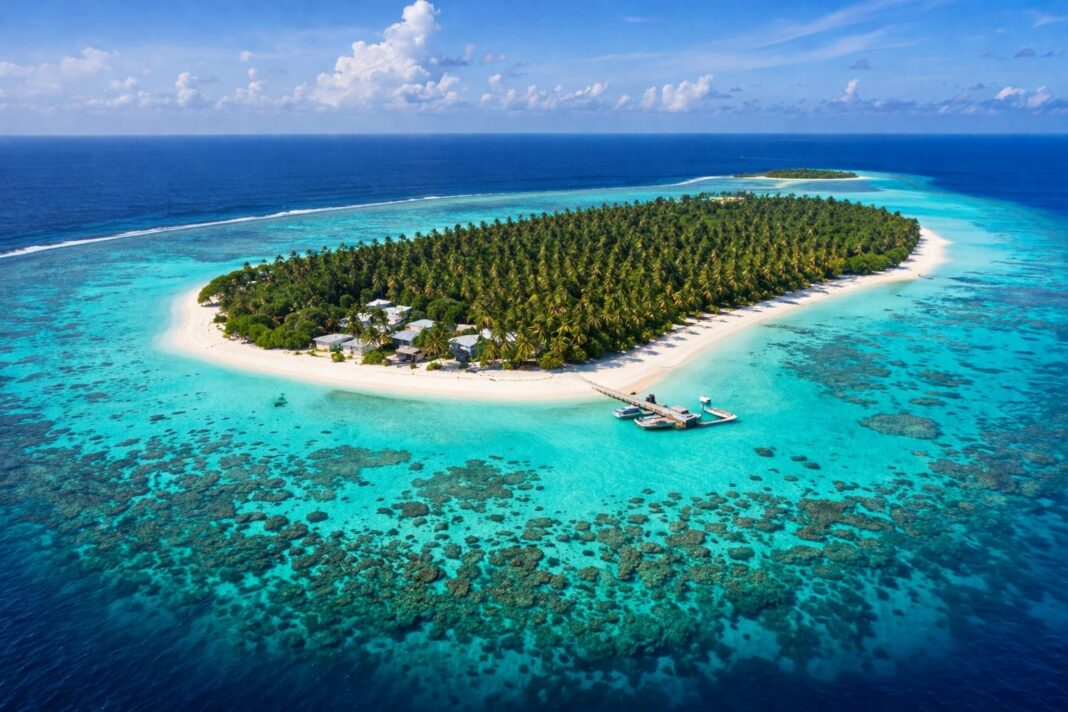
Lakshadweep is not merely a cluster of islands; it is a formation shaped by processes that are both gradual and continuous. Unlike the continental landscapes that define much of India, these islands rise from coral — living structures created over centuries by marine organisms. Located off the southwestern coast of Kerala, the archipelago consists of 36 islands, though only a few are inhabited.
This coral origin defines everything. The land is low-lying, the beaches are composed of fine white sand, and the surrounding waters shift between shades of blue and green. Lagoons encircle many of the islands, creating calm, shallow spaces that contrast with the deeper sea beyond.The geography itself imposes limits. Space is finite, resources are delicate, and the relationship between land and water is immediate. There is little separation between environment and habitation; each shapes the other in visible ways.
Kavaratti and the rhythm of everyday life
At the centre of administrative activity lies Kavaratti, an island that balances governance with everyday life. It does not resemble a capital in the conventional sense. There are no large avenues or dense urban structures. Instead, institutions exist alongside homes, and the pace remains measured.
Kavaratti’s lagoons define its character. Calm and expansive, they serve both ecological and social purposes. Fishing, small-scale transport, and daily interactions unfold along their edges. The island becomes a space where governance and community coexist without overwhelming each other.
Nearby, Agatti Island functions as the primary gateway. Its narrow stretch of land, bordered by lagoon on one side and open sea on the other, reflects the geographical constraints under which the islands exist.
Further away, Bangaram Island offers a quieter experience. With minimal habitation and controlled tourism, it presents the islands in a more undisturbed form.
Coral, lagoons, and the ecology of balance
The ecological significance of Lakshadweep lies in its coral reefs. These reefs are living systems that support diverse marine life. Fish, molluscs, and other organisms depend on this fragile ecosystem, creating a network of interdependence.
Coral reefs also act as natural barriers, protecting the islands from wave action and erosion. Without them, the stability of these landforms would be uncertain. Yet, they are highly sensitive to environmental changes. Rising sea temperatures, pollution, and human activity can disrupt their balance, leading to coral bleaching.
The lagoons surrounding the islands add another dimension. Their calm waters create ideal conditions for biodiversity while supporting traditional fishing practices. Communities living here have developed a relationship with the sea that is both economic and ecological.
In Lakshadweep, nature is not a backdrop. It is a system within which life is organised.
Culture shaped by continuity and proximity
Culturally, Lakshadweep reflects its historical connections with the Malabar Coast while maintaining its own distinct identity. The majority of the population follows Islam, and cultural practices are closely linked with community life.
The local language, Jeseri, carries influences of Malayalam but has evolved uniquely across the islands. Settlements are small and closely connected, reflecting both environmental limitations and social cohesion.
Religious spaces such as Ujra Mosque represent the integration of faith and daily life. These structures are simple, functional, and rooted in local craftsmanship.
Fishing remains central to the economy, particularly tuna harvesting. Coconut cultivation complements this, with coconut trees forming a dominant visual and economic feature. The lifestyle here reflects adaptation rather than expansion — a way of living shaped by what the environment allows.
Tourism without excess
Tourism in Lakshadweep has developed within clear limits. Entry is regulated, permits are required, and visitor numbers are controlled. This approach reflects an awareness of ecological fragility.
Unlike heavily commercialised destinations, Lakshadweep offers a restrained experience. Activities such as snorkelling and scuba diving allow engagement with marine life, but the emphasis remains on observation rather than exploitation.
This model suggests that tourism can exist without overwhelming the environment — that value can be derived from preservation rather than transformation.
Movement, distance, and measured access
Travel within Lakshadweep requires time and planning. Boats connect the islands, while limited air and helicopter services provide additional access. Distances that appear short are experienced differently due to infrastructure constraints.
This relative inaccessibility has helped preserve the islands, but it also highlights the challenges of development. Connectivity, resource management, and logistics must all be approached with care. Lakshadweep exists in a state of measured connection — not isolated, but not fully integrated into high-speed systems either.
Fragility in a changing climate
The beauty of Lakshadweep is inseparable from its vulnerability. As low-lying coral islands, they are particularly susceptible to sea-level rise and coastal erosion. Environmental changes have direct and visible impacts.
Coral bleaching, shifting weather patterns, and rising water levels all pose challenges to long-term sustainability. Managing these risks requires careful planning, regulation, and awareness.
At the same time, the communities here demonstrate resilience. Their practices reflect an understanding of limits — a recognition that survival depends on balance.
A different way of experiencing place
Lakshadweep does not offer spectacle in the conventional sense. It does not rely on dramatic attractions or rapid change. Instead, it invites attention — to the movement of tides, the clarity of water, and the quiet rhythms of life.
Time feels extended here. The absence of excess creates space for observation. Travel becomes less about covering distance and more about experiencing presence.
Where simplicity becomes meaning
Lakshadweep is not defined by scale but by balance. It is a place where land, sea, and community exist in close continuity. Its identity is shaped not by expansion, but by adaptation. To travel here is to engage with a system that operates within limits — ecological, cultural, and spatial. It is to recognise that sustainability is not an abstract idea, but a lived reality.
Lakshadweep does not overwhelm. It reveals — slowly, quietly, and with a depth that lingers.
And in that quiet revelation lies its true significance — a reminder that sometimes, the most meaningful journeys are not those that offer more, but those that allow us to see what already exists with greater clarity.