



New Delhi, Dec 26 (IANS) India has taken over the BRICS+ presidency for 2026, demonstrating its highly enriching founding membership and opportunity to boost the intergovernmental association as a leading geopolitical force in the Global South. With its presidency set to begin in 2026, India has already outlined its framework of priorities for BRICS, a report highlighted on Friday.
Brazil took over the BRICS presidency from Russia in 2025 and India is set to assume its presidency in 2026. Currently, BRICS comprises 10 nations: Brazil, China, Egypt, Ethiopia, India, Indonesia, Iran, Russia, South Africa, and the United Arab Emirates (UAE).
“With India’s presidency in 2026, which is estimated to be a comprehensive and promising eventful year for BRICS, India has already outlined its framework of priorities, as it did during its G20 presidency several years ago,” Kester Kenn Klomegah, an independent researcher and writer on African affairs in the EurAsian region, wrote in Modern Diplomacy.
“In close coordination with members and partner states within the BRICS association, India has to ensure the balance of multifaceted interests and ensure or establish mutual trust in the multipolar world system. The goal of transforming into a full-fledged international organization must go beyond addressing current geopolitical challenges and the necessity to develop effective ways of engaging in global development to reflect multipolarity,” he added.
BRICS Leaders meetings are held once a year on rotational basis. Several ministerial meetings are held in the nation that holds the BRICS presidency like the meetings between foreign ministers, finance ministers, central bank governors, trade ministers, and energy ministers.
In his speech at the BRICS Summit in 2014, Prime Minister Narendra Modi had said that “reform of institutions of global governance … has been on the BRICS agenda since its inception.” Later, prior to the BRICS Summit in Kazan, PM Modi stated that BRICS is only non-Western and it was never meant to be against anyone or be anti-Western. In his remarks at the BRICS Summit in Kazan, PM Modi stated, “We must be careful to ensure that this organization does not acquire the image of one that is trying to replace global institutions.”
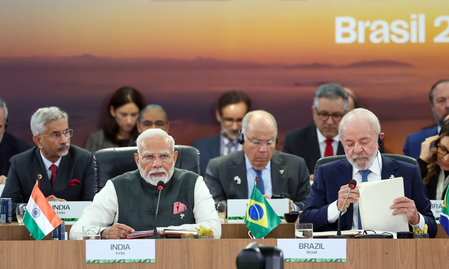
During the BRICS Summit in Rio de Janeiro in 2025, PM Modi announced that India would give a “new form” to BRICS during its presidency in 2026. He proposed redefining BRICS as “Building Resilience and Innovation for Cooperation and Sustainability” and stressing a people-centric approach, drawing parallels with India’s G20 presidency, the Modern Diplomacy report mentioned.
PM Modi said that India would advance BRICS with a focus on “humanity first,” stressing the need for international community to make joint efforts to address common challenges like pandemic and climate change. He called for reforming global institutions to reflect the realities of the 21st century, stressing greater representation for the Global South and slamming outdated structures like the United Nations Security Council and World Trade Organization.
“Since its inception, BRICS has undergone a transformation and has gone through several stages of qualitative change. The organizers are still touting the expansion as part of a plan to build a competing multipolar world order that uses Global South countries to challenge and compete against the Western-dominated world order. There is obvious interest in this consensus-based platform and hundreds of economic and political areas for cooperation and for collaborating, including politics, economic development, education, and scientific research. The New Development Bank finances various projects in member countries: Brazil, Russia, India, China, and South Africa.
“On January 1, 2024, five new members officially entered BRICS, namely Egypt, Iran, the United Arab Emirates, Saudi Arabia, and Ethiopia. At a BRICS Summit in Kazan, Russia, in October 2024, it was decided to establish a category of BRICS partner countries. The first countries to become partners were Belarus, Bolivia, Kazakhstan, Cuba, Malaysia, Thailand, Uganda, and Uzbekistan. The expanded BRICS+ generates 36% of global GDP. That, however, according to the Economist Intelligence Unit, the collective size of the economies of BRICS+ will overtake the G7 by 2045. Today, collectively, BRICS comprises more than a quarter of the global economy and nearly half the world’s population,” the report added.
–IANS
akl/as