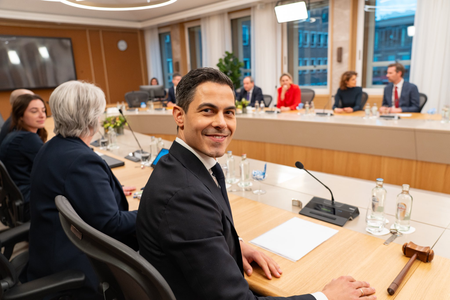
New Delhi, Feb 24 (IANS) Prime Minister Narendra Modi on Tuesday congratulated his new Dutch counterpart, Rob Jetten, on assuming the office of the Prime Minister of the Netherlands and expressed hope for further strengthening the bilateral ties.
In a post on X, PM Modi said, “Congratulations, Mr Rob Jetten, on assuming office of the Prime Minister of the Netherlands. India and the Netherlands share an extensive relationship across diverse sectors. I look forward to working closely with you to add further momentum to the growing ties between our two countries and people.”
India and the Netherlands maintain robust, growing relations based on over 75 years of diplomatic ties, focusing on economic partnerships, sustainable development, and technology. The Netherlands is a top European investor and trade partner for India, with key cooperation in water management, agriculture, health, and defence.
The two nations have a Strategic Partnership on Water covering an extensive cooperation and knowledge sharing in flood management, clear water technologies, among other domains.
Earlier this month, PM Modi met former Dutch PM Dick Schoof on the sidelines of the AI Impact Summit in New Delhi and underscored the need for India and the Netherlands to work together to realise the full potential of Artificial Intelligence to achieve social transformation.
A Dutch minority government was officially sworn in on Monday at Huis ten Bosch Palace in The Hague, more than 110 days after the general election held on October 29 last year.
Following the discharge of the previous cabinet, 18 ministers and 10 state secretaries were sworn in.
The new cabinet is a coalition of Democrats 66 (D66), the People’s Party for Freedom and Democracy (VVD), and the Christian Democratic Appeal (CDA), formed on January 30, Xinhua news agency reported.
Before the swearing-in, incoming Prime Minister Rob Jetten held an introductory meeting with King Willem-Alexander, marking the transition to the new administration.
According to the agreement, the new government will prioritise improving the efficiency of public administration, accelerating housing construction and energy transition, advancing proactive climate policies, promoting high-tech industries to boost economic growth, tightening immigration policies, reforming the social security and healthcare systems and strengthening national security and international cooperation.
A total of 27 parties contested the parliamentary election last October, with 15 winning seats in the House of Representatives. The D66 and the Party for Freedom (PVV) each secured 26 seats, followed by the VVD with 22 and the GreenLeft-Labour alliance (GroenLinks-PvdA) with 20. The CDA and JA21 won 18 and nine seats, respectively.
On January 9, the D66, the VVD and the CDA announced their plan to form a minority cabinet. Forming a government without majority support at the outset is rare in Dutch politics. The three parties together hold 66 seats in the 150-member House of Representatives, 10 short of a majority, and are 16 seats short of a majority in the Senate.
“The Netherlands does not have a tradition of minority cabinets. In that respect, we are in uncharted territory,” the three parties said in their coalition agreement. “The success of this cabinet hinges on its willingness to collaborate with the House of Representatives and the Senate, fellow government bodies, and civil society organisations.”
–IANS
sd/