



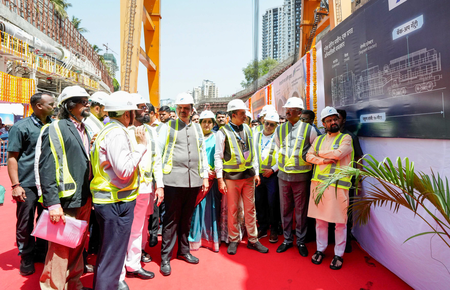
Mumbai, April 7 (IANS) Maharashtra Chief Minister Devendra Fadnavis on Tuesday inaugurated the first phase of Metro Line 9 on the 4.7 km stretch from Dahisar East to Kashigaon, featuring four new stations.
He stated that this connectivity will significantly reduce travel time between Mumbai and Mira-Bhayandar.
The government release said that Metro Line 9 is linked to Metro Line 7 (Red Line), providing a direct link to the Western Express Highway and Andheri East. Travel time that previously took one to two hours due to congestion at the Dahisar toll plaza will now be reduced to just 30 minutes.
The second phase (Saibaba Nagar to Subhash Chandra Bose Ground) is 96 per cent complete. Once finished, Line 9 will eventually connect to Line 3 (Colaba-Bandra-SEEPZ), enabling seamless travel from Mira-Bhayandar to South Mumbai.
CM Fadnavis highlighted that the project is a “Green Project,” incorporating solar energy, rainwater harvesting, and regenerative braking. Notably, the line features a “double-decker” design, similar to Nagpur, where the metro and a flyover share a single pillar.
In a major boost to East-West connectivity, CM Fadnavis also inaugurated the first phase of Metro Line 2B (D.N. Nagar to Mandale), covering the stretch from Diamond Garden to Mandale.
Simultaneously, the Chief Minister performed the e-bhoomipujan for India’s first Pod Taxi project in the Bandra-Kurla Complex.
Metro Line 2B with a 5.6 km stretch and five stations is now operational. This is the first metro line to connect directly with the Harbour Line, creating a massive interchange hub involving Metro 1, Metro 3, Metro 4, Western Railway, and the Monorail.
Spread across 30.45 hectares, this double-decker depot will be one of India’s largest, featuring 72 stabling lines. All stations have received the IGBC Platinum Rating for energy efficiency and natural light optimisation, said the government release.
Further, CM Fadnavis, who was accompanied by Deputy Chief Minister Eknath Shinde, also laid the foundation stone for the Pod Taxi project for Bandra-Kurla Complex to tackle “last-mile” connectivity issues. It is an automated system modelled after similar transit in Dubai and London.
The project will be implemented on a Build-Operate-Transfer basis, with the first phase aimed for completion within 20 months. It will drop commuters within 100-150 metres of their destination, significantly easing Bandra-Kurla Complex’s notorious traffic congestion, said the government release.
Deputy Chief Minister Eknath Shinde remarked that Mumbai’s metro network has now reached 101 km, making it the second-largest in India after Delhi.
The state aims to expand this to 337 km, catering to nearly seven million passengers daily and drastically reducing the load on the suburban railway system.
Following the ceremony, the dignitaries took a maiden ride from Diamond Garden to Deonar station, marking a historic shift in Mumbai’s urban mobility landscape.
–IANS
sj/dan