



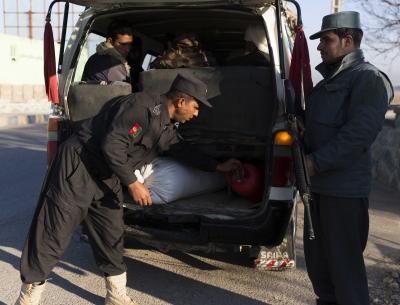
Kabul, Oct 29 (IANS) Spotlighting that majority of narcotics – including traditional and synthetic drugs – are being smuggled into Afghanistan from Pakistan, the Taliban’s Interior Ministry has urged Islamabad to fulfil its responsibility of stopping drug trafficking, local media reported on Thursday.
Taliban’s Interior Ministry spokesperson Abdul Mateen Qani said that the country has intensified efforts to stop drug smuggling and that drug cultivation has reached nearly zero in Afghanistan after the Taliban’s efforts to stop the production of narcotics, the ‘Afghanistan International’ reported.
The spokesperson’s remarks came as reports cited that Pakistan’s Balochistan province has become the main centre for poppy cultivation after the Taliban’s ban on drugs in Afghanistan.Until 2022, 80 per cent of the world’s illicit opium was cultivated in Afghanistan. Taliban claims a 95 per cent drop in opium production since it came to power again.
According to a report released by the United Nations Office on Drugs and Crime (UNODC) in July 2026, the area where poppy was cultivated in Afghanistan witnessed a decline from 232,000 hectares in 2022 to 10,200 hectares in 2025, while production of opium reduced from 6,200 tonnes to around 296 tonnes, Afghanistan International reported. However, the United Nations stated that existing opium stockpiles in Afghanistan were expected to last till the end of 2026.
Meanwhile, Pakistan’s Balochistan province and Sistan-Baluchistan in Iran, both sharing a border with Afghanistan, have witnessed an increase in poppy cultivation in recent years, a report in Radio Free Europe/Radio Liberty (RFE/RL) has detailed, citing satellite imagery and interviews with local farmers.
“The Taliban drugs ban, combined with growing instability in the tri-border area, has created the conditions for widespread poppy cultivation in Pakistan’s Balochistan Province and parts of Iran,” the RFE/RL report quoted David Mansfield, a leading UK-based expert on Afghanistan’s illicit drugs industry, as saying. Mansfield said that the remote and volatile areas of Afghanistan, Pakistan and Iran have, as a result, become a “global centre for opium production.”
Balochistan seems to have become the main centre of opium cultivation in the Afghanistan-Pakistan-Iran border region. Satellite imagery from Alcis, a British firm specialising in satellite analysis, and interviews with local farmers indicate that opium cultivation is widespread in Balochistan.
Mansfield, who authored an August report for Alcis, said, “Satellite imagery assessments identified more than 9,000 hectares of poppy cultivation in Balochistan alone.
Iran has also been witnessing poppy cultivation as Afghan farmers have crossed the borders to cultivate poppies as tenants and sharecroppers. In recent years, opium cultivation has been reported in several provinces of Iran, including Razavi Khorasan, Kermanshah and Lorestan. Sistan-Baluchistan is the main centre of opium cultivation in Iran, with satellite imagery from 2026 showing poppy cultivation in several parts of the province.
–IANS
akl/as