



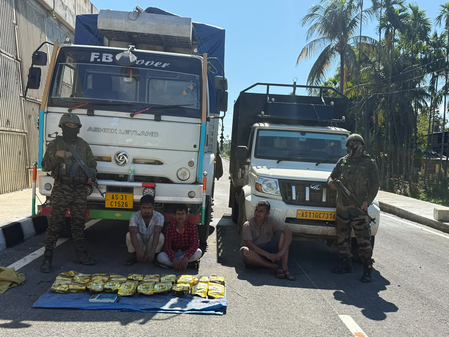
New Delhi, Nov 4 (IANS) Indian intelligence agencies uncovered a transnational narcotics nexus connecting Mexican cartels, the Dawood Ibrahim syndicate, and insurgent groups in Myanmar and India’s northeast, aimed at circumventing aggressive security crackdowns.
With Indian agencies leaving no stone unturned to realise the Narendra Modi government’s vision of a drug-free India, pressure on international drug cartels has intensified, triggering a sense of desperation among their networks.
Drug syndicates operating from Pakistan, Myanmar and Mexico have all faced significant setbacks at the hands of Indian enforcement agencies.
An Intelligence Bureau official said that the earlier rule of these cartels to function in designated jurisdictions appears to be changing now.
“These cartels realise that it would be best to work as one rather than independently. They feel that functioning together would make the job of the Indian agencies harder,” the official said.
The Mexican cartels have been finding it increasingly difficult to operate following crackdowns by the US agencies.
These cartels are finding it increasingly difficult to procure precursor chemicals such as pseudoephedrine, used in the manufacture of methamphetamine, amid mounting pressure from US enforcement agencies.
“The Mexican cartels have been trying to find a way around this problem and are, therefore, in touch with insurgent groups in both India’s Northeast and Myanmar,” the official said.
The idea is to take the help of these insurgent groups to source the precursors for preparing the drugs from Myanmar. These insurgent groups would, in turn, help the Mexican cartels smuggle precursors such as pseudoephedrine through the porous Indian borders.
The Mexican cartels plan to make India a base to produce the narcotics, which would eventually be smuggled into the United States and Europe, the official said.
Another official said that these Mexican cartels are also working closely with the D-Syndicate.
“In fact, recent chatter that the Indian intelligence agencies have intercepted points to the direct links between the Mexican Cartel Jalisco Nueva Generación (CJNG) and Haji Salim,” the official said.
Salim manages the D-syndicate’s South India operations and, in recent times, has suffered major losses owing to successful operations by the Indian law enforcement agencies.
The Mexican cartels have been hit by the Indian agencies too. Between 2024 and 2026, three major seizures of narcotics were made by the Indian Coast Guard of which two were linked to the Mexican and South American cartels.
In November 2024, 6,016.87 kg of methamphetamine worth Rs 36,000 crore was seized in the Andaman Sea from a Myanmar boat. This consignment was linked to the Mexican cartel CJNG.
In May 2025, the Indian Coast Guard, in a joint operation with the Gujarat ATS, seized 115 kg of cocaine worth Rs 1,150 crore at the Mundra Coast in Gujarat.
This shipment had South American origin, the probe had found.
In September 2026, 524 kg of methamphetamine worth Rs 3,000 crore was seized at the Arabian Sea, approximately 160 nautical miles northwest/west of Lakshadweep. Five Pakistani nationals, all linked to Haji Salim, were arrested following this operation.
Another official said that these massive seizures at sea have affected both Haji Salim and cartels such as the CJNG immensely.
Both the D-syndicate and the Mexican cartels decided to team up and smuggle narcotics to avoid such massive losses, the official said.
Officials say that the teaming up of the D-syndicate and the Mexican cartels poses another challenge.
Apart from narcotics, these networks are also likely to engage in arms trafficking. The proceeds from drug and arms smuggling are allegedly channelled by Pakistan-based cartels to terror groups operating against the Indian State.
A similar scenario is emerging in the northeast, where money generated through this trade would be used to fund insurgency.
“Both the insurgent groups in the Northeast and the Pakistan-based drug syndicates have a lot to gain from this association with the Mexican cartels. First, the operations would be unified, and this makes it harder for the Indian agencies. Secondly, the money that would be generated by working alongside the Mexican cartels is much bigger, and this helps in both fuelling terror and insurgency that would have an impact on India’s national security,” the officials said.
–IANS
vn/snj/skp