




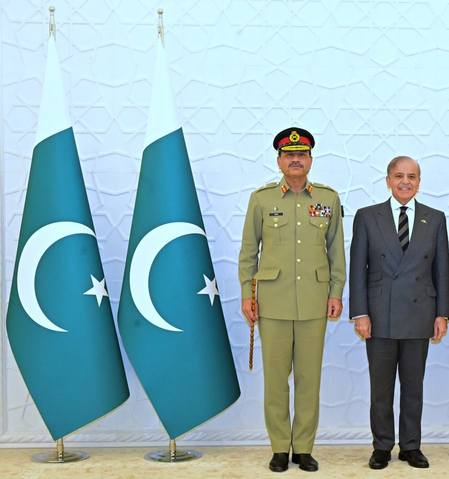
Dhaka, Jan 15 (IANS) Grappling with severe economic crisis, political instability and militant violence at home, Pakistan cannot afford to pursue a foreign policy driven by the ambitions of a security establishment which is eager to project power abroad even as stability at home remains elusive, a report highlighted on Thursday.
Highlighting Islamabad’s diplomatic overstretching and doublespeak, it detailed how Pakistan’s Prime Minister Shehbaz Sharif, along with senior cabinet members, including Deputy PM and Foreign Minister Ishaq Dar, was meeting UAE President Sheikh Mohammed bin Zayed at his family’s palatial estate in Rahim Yar Khan on the very morning Saudi Arabia carried out strikes against what it described as Emirati-linked weapons shipments.
“The optics were ironic with Pakistan professing solidarity with Riyadh while hosting the very leader Riyadh was pressuring militarily… There have been unsubstantiated reports that Saudi Arabia declined a request for a meeting by Pakistan’s powerful army chief, Field Marshal Asim Munir, thereby reinforcing the impression that Islamabad’s balancing act was wearing thin,” author and columnist Arun Anand wrote in Bangladeshi weekly Blitz.
Such moments, the report mentioned, are not mere coincidences but rather symptoms of a deeper strategic malaise of a military-dominated foreign policy that repeatedly entangle Pakistan in conflicts it neither controls nor fully understands.
“Over the past decade, Pakistan has drifted from being a peripheral player in the Middle East to an increasingly exposed one. As the shift has been shaped by transactional military diplomacy as signified by the recent Strategic Mutual Defence Agreement with Saudi Arabia, the result is a country wedged uncomfortably between rival power centres with China and the United States on one axis globally, and Saudi Arabia and the UAE on another at the regional level. While each of its allies expects loyalty, no one offers insulation when loyalties collide,” the report adds.
For Islamabad, the proposition of deploying Pakistani troops to the war-battered Palestinian region is also fraught with peril. US President Donald Trump has publicly sought Pakistan’s commitments to contribute troops to his envisioned security or stabilization force for the territory.
“The Gaza stabilisation force would almost certainly involve disarming Hamas, enforcing cease-fire arrangements, and operating under an American or Israeli security framework, such a role would place Pakistan at odds with popular sentiment at home, where sympathy for the Palestinian cause runs deep. Moreover, it would also damage the country’s standing in the broader Muslim world, where participation in what many would view as an externally imposed security regime or forced disarming of what many consider a Palestinian resistance group would be seen as complicity with Israel,” the Blitz article details.
“However, if the Pakistan Army assumes such a role, it won’t be its first as it has a history of renting its role to the regional players. Pakistani military officers played a role in assisting Jordan’s Hashemite monarchy during the 1970 Black September crisis by helping violently crackdown on Palestinian fighters. The Pakistani contingent in Amman was overseen by Brigadier Mohammad Zia-ul-Haq, who would later seize power in 1977 and rule as a military dictator. That episode left a lasting scar on Pakistan’s image among Palestinians and repeating such a role in Gaza would be exponentially more damaging,” it added.
Gaza, of course, is not the only front where Pakistan’s Middle East policy is unravelling.
Pakistani army chief Asim Munir signing a $4.6 billion defence deal with Khalifa Haftar in Benghazi last month – reportedly the largest arms deal in Pakistan’s history – can be described as another strategic overextension without any clarity.
“Though the deal on paper signifies Pakistan’s strategic reach, however, in reality, it was a diplomatic misstep of the highest order. Firstly, Libya is a divided country with rival governments governing it in parts. There is Abdul Hamid Dbeibeh’s internationally recognised Government of National Unity (GNU) in Tripoli and then the other, Khalifa Haftar’s Benghazi-based unrecognised Government of National Stability (GNS). Secondly, Libya remains under an international arms embargo imposed by the United Nations in 2011. Therefore, any major weapons transfer and that too to an unrecognised entity risks undermining international law.
“This deal does not only fly in the face of UN sanctions; it also puts constraints in Islamabad’s regional policy. By publicly aligning itself with Haftar, Pakistan effectively chose sides in a complex regional proxy contest as the military strongman is backed by the UAE and Egypt whereas the GNU, by contrast, enjoys the support of the United Nations and Saudi Arabia. Islamabad’s outreach to Benghazi thus undercuts its relationship with Riyadh, at precisely the moment when Saudi goodwill is most needed,” the report details.
These choices, it mentioned, shows that the Pakistani military leadership appears to believe that visibility equals influence, that being “in the room” guarantees relevance. However, in practice, it has made Pakistan vulnerable to pressure from stronger powers with clearer agendas.
“If Pakistan continues down this path and gets entangled in Gulf rivalries, is pressured to send troops to Gaza, and aligns with contested actors like Khalifa Haftar, it risks becoming a pawn than a mediator its elite envisions. In the Middle East’s unforgiving geopolitical chessboard, pawns are easily sacrificed,” the report concluded.
–IANS
/as