



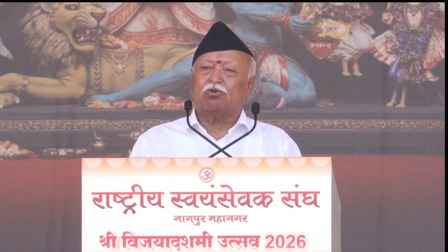
Mumbai, Oct 20 (IANS) In a direct address to ongoing political agitations across the country, Rashtriya Swayamsevak Sangh (RSS) Sarsanghchalak Mohan Bhagwat declared on Tuesday that attempts to force a “regime change” in India will fail.
Delivering his annual Vijayadashami address in Nagpur, the RSS chief emphasised that public movements must aim to resolve issues rather than stoke social animosity or serve short-term electoral gains. His remarks came in the backdrop of recent anti-Election Commission demonstrations and persistent calls by political opponents demanding systemic overhauls.
Drawing explicit comparisons to recent geopolitical upheavals, Bhagwat pointed to violent unrest and political instability observed across several foreign nations. “A storm has blown in the West. Look at what transpired in France, Bangladesh, and Nepal,” Bhagwat stated, warning against similar foreign or domestic tactics inside India. “Regime change will not happen in India. Such attempts continue in India as well. India has moved forward with steadfast resolve, and the collective vitality (purushartha) of its society has grown.”
He cautioned that engineered agitations that aim to dislodge elected systems under the guise of public protest do not solve fundamental problems, noting that changing regimes does not automatically fix societal challenges.
While acknowledging that public discontent and organised protests are natural components of a functioning democracy, the RSS leader insisted that movements must remain within the “boundaries of propriety” (mariyada). “Movements must be directed exclusively towards finding constructive solutions rather than causing friction. Public demonstrations must not sow hatred or hostility among different sections of society. Agitations guided purely by the pursuit of votes or cheap popularity harm long-term stability,” said Bhagwat.
He further added, “Lasting solutions do not emerge from continuous protest alone, but through mutual discourse and constructive dialogue within society.
“Problems arise, and movements take shape; however, these should be directed towards finding solutions. The primary objective must be a resolution,” Bhagwat noted, urging political parties and movement leaders to prioritise social harmony over political opportunism.
Bhagwat outlined a strong vision for national integration and global leadership. Emphasising the distinction between eternal values and evolving societal dynamics, Bhagwat urged citizens to ground themselves in ‘Svabodh’ (self-awareness) while adapting flexibly to modern challenges.
The RSS chief stressed that while diversity is dynamic, the underlying principle of unity in India remains eternal and immutable.
Referring to the Preamble of the Indian Constitution –“We, the People of India” — he highlighted that emotional integration lies at the heart of Indian society. He noted that forgetting these core values and losing sight of right conduct historically weakened the nation, leading to foreign subjugation.
Reflecting on the sacrifices made by freedom fighters for the nation’s independence, the RSS chief stated that safeguarding India’s identity and sovereignty today demands an even greater commitment. He placed the responsibility of steering India towards becoming a global leader (Vishwaguru) squarely on the shoulders of the younger generation.
Addressing recent natural calamities, including environmental disruptions in Nepal and across the Himalayan belt, Bhagwat cautioned against unbridled development. He warned against development models that disregard ecological balance, stating that progress must be inclusive and sustainable rather than destructive to human existence.
Highlighting growing geopolitical conflicts across the globe, Bhagwat asserted that India holds the ideological answers to world peace. On technological advancements, he acknowledged the benefits of information accessibility but emphasised the necessity of critical thinking, moral discretion, and wisdom. He urged governments and administrative bodies to carefully regulate information channels to ensure public safety and accurate information flow.
Reaffirming the country’s ancient traditions, Bhagwat noted that India’s strength lies in accepting, respecting, and embracing diverse languages, castes, regional cultures, and customs. He concluded that the flexibility inherent in the Sanatan tradition provides the foundation for harmonious co-existence.
“The principle of unity is eternal and unshakeable, whereas our diversity is dynamic. Flexibility in diversity is the hallmark of Sanatan philosophy. The responsibility to make India a Vishwaguru now rests on the shoulders of the new generation,” he remarked.
–IANS
sj/dpb