



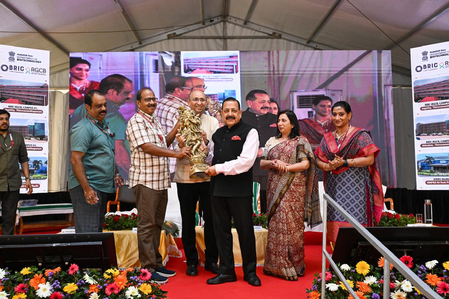
Thiruvananthapuram, Feb 28 (IANS) Emphasising a decisive shift toward a bio-driven economic paradigm, Minister of State (MoS) Jitendra Singh said on Saturday that the Centre’s BioE3 Policy reflects a long-term strategic vision positioning biotechnology at the heart of India’s growth trajectory.
Addressing a gathering after laying the foundation stone for a state-of-the-art current Good Manufacturing Practice (cGMP) facility at the Akkulam campus of BRIC-Rajiv Gandhi Centre for Biotechnology (RGCB), the Minister of State underscored the expanding scope of nuclear medicine research following recent liberalisation measures by the Union government.
He urged national R&D institutions to pursue interdisciplinary collaborations, particularly with private industry, noting that the opening up of the nuclear medical mission creates fresh opportunities for integrated research and translational applications.
Minister of State Singh also dedicated the National Facility for Recombinant Cells and Sensors and inaugurated the annual Science Day programme at the campus.
He said that India is among the few countries to introduce an exclusive biotechnology framework, the BioE3 (Biotechnology for Economy, Environment and Employment) Policy, which aligns scientific innovation with economic sustainability, green transitions and circular economy models.
Referring to the recently announced Biopharma SHAKTI Mission, Minister of State Singh said policymakers recognise that the global economy is increasingly bio-driven.
Over the past decade, he noted, science domains particularly biotechnology have received unprecedented prioritisation.
Highlighting institutional achievements, Minister of State said that BRIC-RGCB researchers have built strong competencies in molecular biology, genomics, disease biology and cancer research, attracting scholars nationwide in sequencing, bioinformatics and interdisciplinary sciences.
Rajesh Gokhale, Department of Biotechnology Secretary and BRIC Director General, described biotechnology systems as transformative for national progress and said the BioE3 Policy 2024 spans six thematic sectors, including bio-manufacturing.
He added that government-backed human papillomavirus (HPV) vaccination initiatives have drawn upon data generated at the institute.
According to BRIC-RGCB Director (Additional Charge), T.R. Santhosh Kumar, the Recombinant Cells and Sensors facility now houses 600 to 700 stable cell lines targeting multiple cancer pathways, positioning the centre as a significant global resource.
The upcoming cGMP facility, Kumar said, will enable cost-effective cell and gene therapy models, expanding access to next-generation treatments.
–IANS
sg/khz