



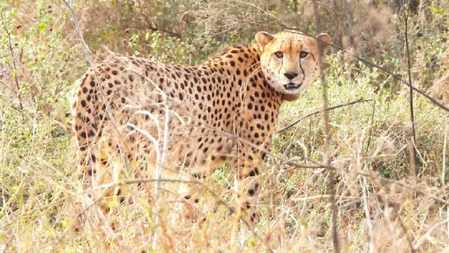
Bhopal, Sep 21 (IANS) A Namibian cheetah brought to India under the ambitious Project Cheetah died at Madhya Pradesh’s Kuno National Park on Monday while undergoing treatment, days after it was rescued from the wild in a weak and dehydrated condition.
Gaurav, aged over 10 years, was found weak and lethargic in the wild on September 12 and was subsequently rescued and shifted to a quarantine boma at Palpur for treatment and close monitoring.
“Gaurav was found to be markedly weak, with visible muscle wasting and severe dehydration. Immediate systemic and supportive treatment was provided, following which he was shifted to Palpur and kept in a Quarantine Boma for close observation and further management,” the Director of Kuno National Park and Cheetah Project said in a statement.
Preliminary clinical examination had indicated severe muscle weakness and dehydration, while an underlying chronic condition was suspected, officials said. Despite continued treatment and supportive care, Gaurav’s condition deteriorated, and he died at around 4 pm on Monday.
The exact cause of death has not yet been established. A post-mortem examination will be conducted, and samples collected from the animal will be analysed to determine the cause.
“The exact cause of death will be ascertained after post-mortem examination and analysis of the samples collected. Further details will be available once the reports are received,” the director added.
Following Gaurav’s death, 51 cheetahs remain at Kuno, including 36 born in India, of which 16 are currently ranging freely in the wild. Four more cheetahs are housed at Gandhi Sagar Sanctuary in Madhya Pradesh, taking India’s total cheetah population to 55.
The development comes four years after India launched Project Cheetah on September 17, 2022, with the translocation of eight cheetahs from Namibia to Kuno. A second batch arrived from South Africa in February 2023, followed by another batch from Botswana in February this year.
The programme seeks to re-establish a viable cheetah population in India after the species became extinct in the country in 1952. Kuno remains the principal site of the programme, while Gandhi Sagar has emerged as a second habitat.
The project has also recorded breeding in India, including the birth of four cubs in the wild to an Indian-born female cheetah in April this year.
–IANS
pd/dan