



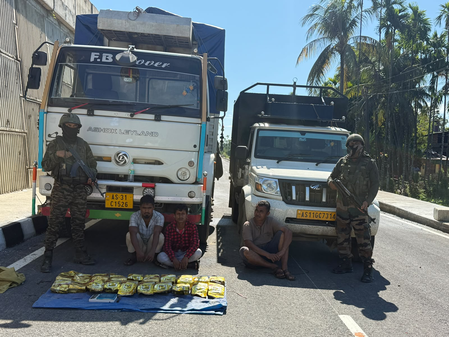
New Delhi, Nov 2 (IANS) India’s northeastern region remains a major security challenge for agencies working to track and dismantle narcotics networks and cartels operating in the area.
The region’s drug trade is largely fuelled by narcotics smuggled from neighbouring Myanmar. Security agencies acknowledge that achieving the goal of a drug-free India by 2029 will be a difficult task, but maintain that it is not impossible.
An official said the approach to tackling the narcotics menace in the Northeast has undergone a significant shift. Merely seizing drugs will not resolve the problem, particularly in this region.
Agencies have now adopted a network-centric strategy aimed at dismantling the entire supply chain and targeting the sources, financiers and operators behind the drug trade.
“All these years, the focus was on seizures. However, this was not sufficient as the cartels kept generating more narcotics. This explains why we have decided to go after the network itself, so that the entire supply chain is shut down,” the official said.
Officials who are part of operations that are being undertaken in the northeastern states counter problems on multiple levels.
Compared with Punjab or Jammu and Kashmir, the battle is immensely cumbersome in the northeastern states. The terrain is the biggest challenge, and this is why at times the narcotic cartels have an upper hand.
An Intelligence Bureau official said the scale of operations in the region is also what adds to the challenge.
Myanmar has replaced Afghanistan as the world’s largest illicit opium producing nation. The Myanmar cartels were already notorious for producing and smuggling brown sugar, finished heroin and the synthetic drug, methamphetamine.
Adding opium to the mix has made the problem far more complex, the official said.
With such a large variety of drugs coming in from Myanmar, the agencies are also facing immense problems at the border.
The 1,643 km India-Myanmar border is largely unfenced and these cut through dense forest areas and terrain in Mizoram, Nagaland, Arunachal Pradesh and Manipur.
Local communities such as Nagas and Mizos have been resisting the fencing of the border. The problem, however, is not just the India-Myanmar border. A large quantity of drugs is also being pushed into Assam, West Bengal, Mizoram and Tripura through the Bangladesh border.
Another official said that with so many challenges, the seizure-only approach will not work. This is why focusing on the networks is important.
“The Enforcement Directorate (ED) too is doing its part in identifying money trails. While it may be hard to shut down the money trail that emanates out of Myanmar and Bangladesh, it is very much a possibility to do so within India,” the official said.
The ED has traced 1,400 mule accounts that belong to traders in India. These traders were found to be helping drug syndicates procure goods and have them exchanged for drugs.
The ED found that the drugs are produced in Myanmar and then carried across the Tiau River in Zokhawthar, which is the border crossing opposite Khawmawi in Myanmar.
The drugs then make their way into Champhai in Mizoram, following which they travel to Aizawl, Vairengte, Assam, and then to the rest of India. Transactions are handled by illicit money exchanges and hawala networks in Champai.
The hawala money that reaches Champai comes in from Delhi, Kolkata and Mumbai. On the face of it, the transactions that are taking place in India look legitimate. The traders who are on the payrolls of these drug cartels are tasked with procuring petrol, diesel, medicines, edible oil, flour, clothing and footwear.
The purchase of these items looks legitimate as the procurement involves a GST invoice. Once these items reach the northeast, they are exchanged for drugs, which basically means that these cartels are indulging in the age-old barter system.
There is money transaction only within the Indian border, and these look legitimate. Following the barter in the northeast, the items move to Myanmar, which eliminates any money trail.
Once these items reach Myanmar, they are marketed commercially, the ED probe found.
Officials say that the cartels that operate between Myanmar and the northeastern states are the most sophisticated.
A couple of seizures do not matter to them at all, as they are capable of producing drugs on a very large scale. 1,000 to 1,080 metric tonnes of opium are produced in Myanmar annually.
Further, billions of yaba tablets are being pumped into India every year. Apart from this, huge quantities of crystal methamphetamine and ketamine are also being pushed in.
If the agencies continue to focus only on seizures, the system is bound to get stressed very soon due to the quantity in which drugs are produced and pushed into India. This is why a network-centric approach whereby the root of the problem is destroyed is what will help end the menace in the long run, an official said.
–IANS
vn/snj/skp