



Sydney, January 10 (Indian Abroad Newsdesk)
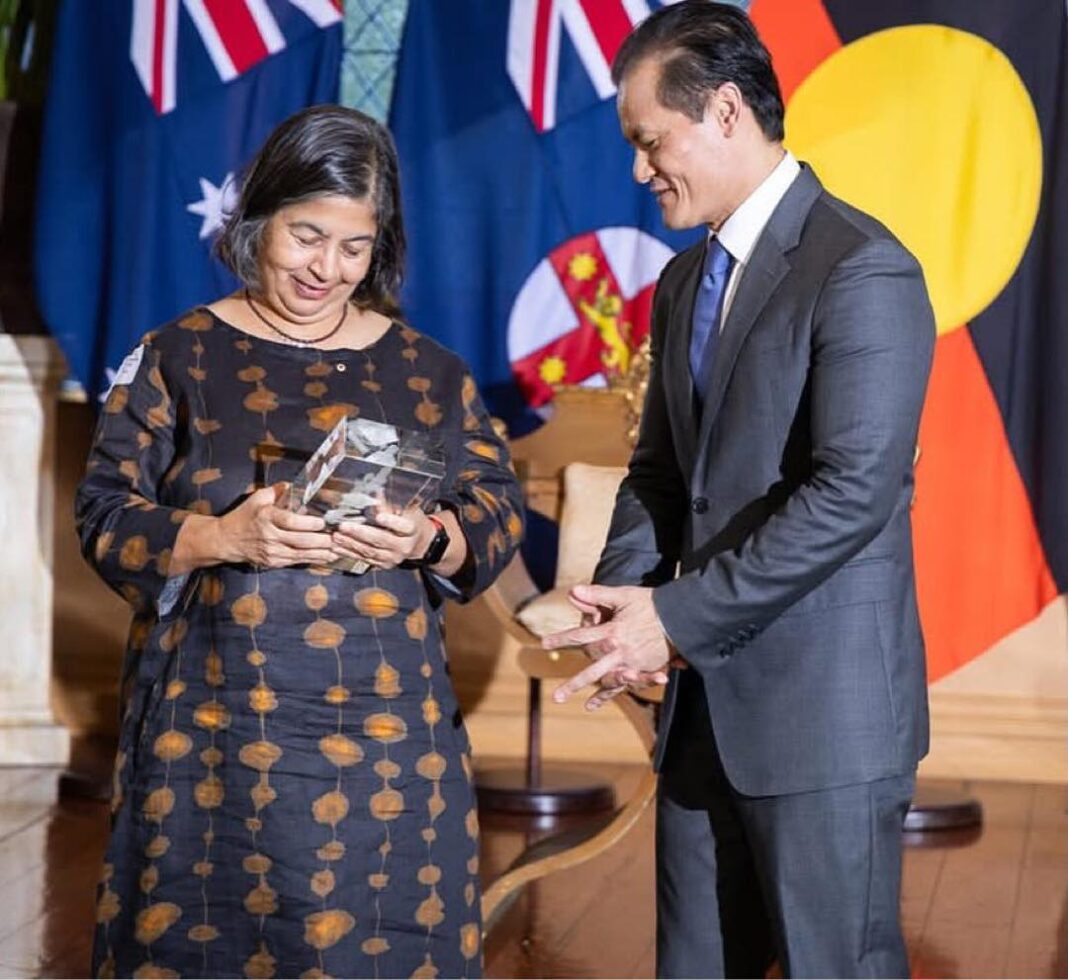
Eminent Indian-origin mathematician Nalini Joshi AO has been named the 2025 New South Wales Scientist of the Year, making history as the first mathematician to receive the state’s most prestigious science honour. The announcement was made at the NSW Premier’s Prizes for Science & Engineering ceremony held at Government House.
A distinguished professor of applied mathematics at the University of Sydney, Professor Joshi was recognised for her far-reaching contributions to mathematical sciences. Her pioneering research has deepened global understanding of complex systems, including the transmission of light through optical fibres and the occurrence of unpredictable rogue waves in deep oceans—areas with significant relevance to climate research and communications technology.
The award marks a significant milestone for the scientific community, highlighting the essential role of mathematics in solving practical scientific and technological problems. Professor Joshi’s achievement has resonated internationally, with the Australian High Commission in India acknowledging her honour on social media and celebrating her contribution to international scientific collaboration.
Her research portfolio also spans emerging fields such as quantum technologies and cybersecurity. She has underscored the need for strong mathematical frameworks as advances in quantum computing may one day pose challenges to existing digital security systems. Her work helps lay the groundwork for addressing such future concerns.
In addition to her research excellence, Professor Joshi is widely known for her advocacy for gender equality in science. She is a co-founder of the Science in Australia Gender Equity (SAGE) initiative, which works to improve the participation and retention of women in science and mathematics.
Commending her achievements at the ceremony, New South Wales Premier Chris Minns said Professor Joshi’s work helps unravel “nature’s big mysteries” while motivating future generations to pursue careers in science.