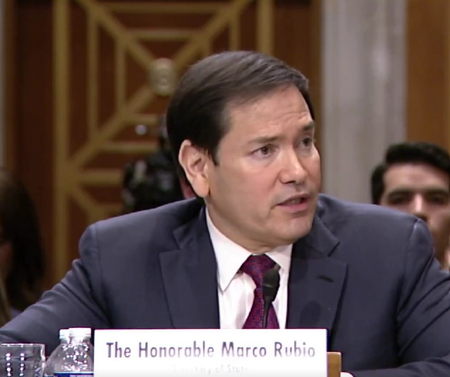
Washington, Jan 29 (IANS) US Secretary of State Marco Rubio has defended Washington’s oversight of Venezuelan oil revenues, telling senators that the arrangement was necessary to prevent economic collapse while the country transitions away from corruption and mismanagement.
Rubio on Wednesday (local time) said Venezuela was facing an immediate crisis after the removal of Nicolas Maduro, with oil production continuing but no place to store or sell crude.
“They were producing oil, they were drilling, but they had nowhere to put it,” he said. “They were facing a fiscal crunch.”
To address that, Rubio said the US allowed sanctioned oil to reach global markets at market prices, with strict conditions. “The funds from that will be deposited into an account that we will have oversight over,” he said.
He said the money is intended to cover basic needs. “They needed money and the immediacy to fund the police officer, the sanitation workers, the daily operations of government,” Rubio said.
He stressed that the mechanism is temporary. “This is not going to be the permanent mechanism,” he said. “This is a short-term mechanism.”
Rubio said Venezuela has agreed to submit monthly budgets detailing how funds will be used. “We will provide for them at the front end what that money cannot be used for,” he said.
He also said part of the money will fund an audit system.
“They will agree to pay for and fund an audit system acceptable to us to ensure that that’s how the money was spent,” he said.
Responding to concerns about corruption, Rubio acknowledged the risks. “We are dealing with individuals that have been involved in things that in our system would not be acceptable,” he said.
But he argued that engagement is unavoidable. “You have to work with the people that are in charge of the elements of government,” Rubio said.
He said Venezuela has already taken steps toward reform, including passing a new hydrocarbon law. “They have passed a new hydrocarbon law that basically eradicates many of the Chavez-era restrictions on private investment,” he said.
“It probably doesn’t go far enough, but it’s a big step from where they were three weeks ago,” Rubio added.
He said oil policy is central to Venezuela’s recovery, but warned that investment will only come with legal certainty.
“Companies are only going to invest somewhere if they know we’re going to make our money back with a profit and our land isn’t going to be taken from us,” he said.
For India, a major oil importer with long experience navigating sanctions and energy geopolitics, the hearing highlighted how oil revenues, sanctions enforcement and political transition are being tightly linked in US foreign policy.
–IANS
lkj/sd/