




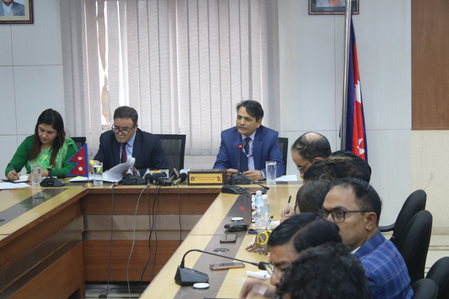
Kathmandu, March 3 (IANS) The Nepali government has formed an Emergency Response Team to address the safety concerns of Nepali nationals residing in West Asia as the ongoing US-Iran conflict engulfs the region.
More than 1.7 million Nepali nationals are residing in 12 countries in the region, and their safety remains a high priority of the government, the Ministry of Foreign Affairs said on Tuesday.
“The government has formed an Emergency Response Team under the coordination of the Foreign Secretary to effectively address concerns about the safety of nearly 1.8 million Nepalis living in the region,” Ram Kaji Khadka, joint secretary at the ministry, told the press on Tuesday.
The team comprises joint-secretary-level representatives from several government agencies, including the Office of the Prime Minister and Council of Ministers; the Ministries of Home Affairs, Finance, Law, Culture, Tourism and Civil Aviation, and Education; as well as the Department of Foreign Employment and the Department of Consular Services, among other agencies. The mechanism aims to ensure coordinated, prompt, and effective action.
Given the large number of Nepalis residing in the war-hit Middle East, their safety and employment have become major concerns for the Himalayan nation, as remittances sent by them are a key lifeline of the Nepali economy.
As retaliatory strikes by Iran in response to joint attacks by the US and Israel hit several civilian installations in Gulf countries, millions of Nepalis — most of them migrant workers — face potential safety risks.
The government has already confirmed that a Nepali youth, Diwas Shrestha, from the western Gorkha district, was killed during a drone interception operation at Zayed International Airport in Abu Dhabi, UAE.
The ministry, however, said that other Nepali nationals have remained safe so far. It also stated that the Department of Consular Services has developed a secure online system to collect updated information on Nepali nationals in the affected region. Nepali diplomatic missions have already issued public notices to facilitate the process.
According to the ministry, the system is intended to enable swift rescue, counselling, and other consular services as required.
Khadka further said that the ministry has instructed Nepal’s 10 diplomatic missions in West Asia — the embassies in Tel Aviv, Doha, Riyadh, Abu Dhabi, Manama, Kuwait, Muscat, and Cairo, as well as the consulates general in Jeddah and Dubai — to send regular “situation analysis reports.”
The ministry has also urged Nepalis to avoid unnecessary risks and to follow advisories issued by the respective governments, as well as official information released by the ministry and Nepali missions in the region, and to fully comply with safety measures.
–IANS
scor/uk