




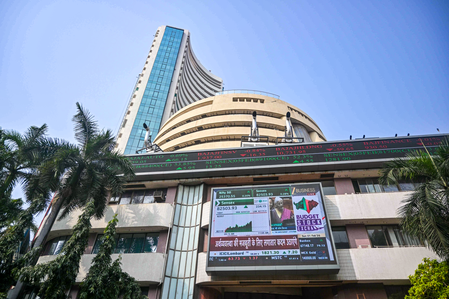
Mumbai, July 25 (IANS) The Indian equity benchmarks posted strong weekly loss, over global inflation fears and higher crude prices.
Nifty lost 2.33 per cent during the week and dipped 0.43 per cent on the last trading day to reach 23,767. At close, Sensex was down 331 points, or 0.43 per cent, at 76,059. It lost 2.68 per cent during the week.
“Inflationary fears intensified as the escalation of the West Asia conflict and the blockade at the Red Sea helped crude to cross the $100 per barrel mark. Market expectations for a September rate hike have firmed up with both US and domestic yields edging higher during the week,” an analyst said.
Domestic investor sentiments were weighed down by return of US tariff-related uncertainties, creating headwinds for export-oriented sectors.
Overall investor sentiment stayed cautious due to lingering geopolitical tensions in the Middle East, weakness across Asian markets and renewed concerns over US trade tariffs.
July PMI data signalled moderation in business activity and softer economic sentiment, leading to a steady decline through the week, with large-cap stocks bearing the brunt of the selling pressure and underperforming the broader market, a market participant said.
On the sectoral front, banking and real estate witnessed significant selling pressure while FMCG and auto stocks emerged as outperformers, supported by strong quarterly earnings.
While the earnings momentum is expected to improve meaningfully only from H2 FY27, that recovery now remains contingent on crude prices stabilising and tensions in West Asia easing, analysts noted.
Broad market indices performed in line with benchmark indices, as Nifty Midcap100 dipped 1.90 per cent, while Nifty Smallcap100 declined 2.18 per cent during the week.
Immediate resistance levels for Nifty are placed at the 23,800-24,000 region and the 23,700–23,600 zone is expected to provide immediate support.
Also, immediate support for Bank Nifty is placed in the 56,000-56,100, while resistance is seen at 56,800–56,900 zone.
Investors remain keen on crude oil price movements and evolving global monetary policy expectations.
Apart from the US Fed’s policy decision, inflation data, and GDP growth numbers that influence the global interest rate outlook, investors will also closely track domestic IIP data.
—IANS
aar/na