



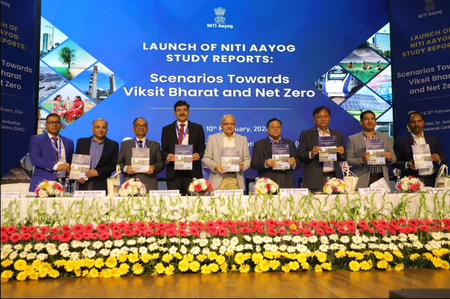
New Delhi, Feb 10 (IANS) The NITI Aayog on Tuesday released the second set of four Study Reports on Scenarios Towards Viksit Bharat and Net Zero, which cover the transport, industry, power, and critical minerals sectors.
According to the reports, electricity’s share in the power sector can rise as high as 60 per cent in 2070 from 21 per cent in 2025, while the share of non-fossil generation increases from 23 per cent to 80-85 per cent. Electricity, biofuels, and hydrogen can meet nearly 90 per cent of transport energy demand by 2070.
In the industry sector, the demand for steel, cement and aluminium is set to increase 4-6 times by 2070, while electricity and green hydrogen emerge as the backbone of industrial energy.
As far as critical minerals are concerned, as much as 20-25 per cent of copper and graphite demand could be met through recycling by the mid-century.
The report on Scenarios Towards Viksit Bharat and Net Zero – Sectoral Insights: Transport (Vol. 3) assesses the current state and long-term evolution of India’s mobility ecosystem, covering passenger and freight demand, modal composition, technological maturity, and energy use. With passenger and freight transport projected to rise, modal shift, zero-emission vehicles, clean fuels and technologies, and structural shifts toward public and shared mobility solutions and rail and waterway transport are identified as essential components of the transition.
The Scenarios Towards Viksit Bharat and Net Zero – Sectoral Insights: Industry (Vol. 4) report examines the various facets of industrial energy transition, including industrial output, energy demand, and emissions across major subsectors, including steel, cement, aluminium, textiles, and petrochemicals. Increasing electrification, material efficiency and recycling, share of non-fossil energy, and leveraging emerging technologies emerge as the way forward.
Scenarios Towards Viksit Bharat and Net Zero – Sectoral Insights: Power (Vol. 7) report examines the central role of electricity in India’s development and Net Zero agenda, assessing future electricity demand, low-carbon supply options, system reliability, and investment requirements. Demand is projected to rise sharply due to increasing urbanisation, cooling needs, digitalisation, electric mobility, and green hydrogen production. The report evaluates pathways for rapid electrification, large-scale renewable deployment, and storage and transmission expansion for a reliable, affordable, and progressively clean power system.
The fourth report on Scenarios Towards Viksit Bharat and Net Zero – Critical Mineral Assessment: Demand and Supply (Vol. 10) estimates mineral requirements arising from India’s deployment of clean technologies across key segments such as solar, wind, battery energy storage systems, EVs, and electrolysers. Avenues to de-risk the critical mineral supply chain and meet India’s future requirements through coordinated action across the development of domestic resources, international sourcing, institutional reforms, and circularity are discussed.
In his address, NITI Aayog Member, Dr V. K. Saraswat, said: “Energy, industry, and transport are the engines of India’s economy. Along with the challenge of Viksit Bharat 2047 and achieving Net Zero by 2070, lies the opportunity to shift to clean energy, to new fuels like green hydrogen and lock in efficiency gains. India needs to move forward rapidly on implementation; a huge effort is required to bring in the technologies that are needed and to reduce their costs.”
NITI Aayog CEO, B.V.R Subrahmanyam, said: “Power, transport and industry sectors cover 80 per cent of the energy transition. Demand for materials like steel, cement, and aluminium will go up rapidly, even with demand management. The hard-to-abate sectors in industry are the toughest challenge. We will have to electrify to the extent possible, enhance circularity, rely on substitution of industrial processes, and increase efficiency.”
–IANS
sps/vd