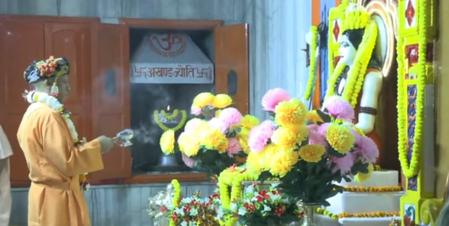




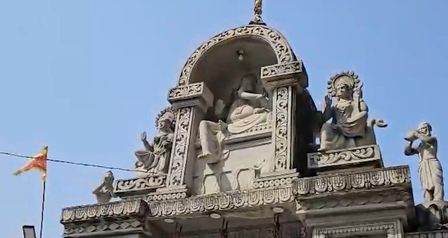
Greater Noida (UP), Oct 20 (IANS) While Dussehra is celebrated across India by burning the effigies of Ravan, Meghnad and Kumbhkaran to symbolise the victory of good over evil, Bisrakh village in Uttar Pradesh’s Greater Noida follows a distinct tradition of worshipping Ravan instead.
Located around 30 kilometres from the national Capital, the village is believed to be the birthplace of Ravan, the demon king from the Hindu epic Ramayana.
Unlike other parts of the country, residents here refrain from burning his effigy, considering the practice disrespectful to their ancestors. Instead, devotees offer prayers and perform religious rituals for Ravan.
Speaking to IANS, Mahant Ramdas Maharaj said the village holds a special place in local religious beliefs and is associated with sages Brahma and Pulastya.
“This is Ravan’s birthplace and was once the ashram of Sage Brahma and Sage Pulastya. Ravan is worshipped here every day throughout the year. Today is Dussehra, and a ‘yagya’ is being performed. The temple has been beautifully decorated, and special prayers are being offered to Ravana,” he said.
He added that people from several areas visit the temple on the occasion to offer flowers and sweets. Religious ceremonies, including ‘havans’, are conducted during the day and continue into the evening.
According to local tradition, Bisrakh was earlier known as Vishveshara, a name associated with Ravana’s father, Vishrava. It is believed that Sage Vishrava was born in the village during the Treta Yuga and established a Shiva Lingam there. Ravan, who was a devotee of Lord Shiva, is also believed to have worshipped at the site.
The temple has attracted growing attention on social media, bringing visitors from different parts of the country to witness the village’s distinctive Dussehra observance.
Bisrakh is not the only place where Ravan receives religious reverence. A temple in Uttar Pradesh’s Kanpur follows a different tradition, with devotees offering prayers to the ten-headed king instead of celebrating his destruction.
The Dashanan Temple, located within the Kailash Temple complex in the Shiwala area of Kanpur, is known for its unique tradition of opening its doors only once a year, on Vijayadashami. The temple remains closed for the other 364 days.
Speaking to IANS, temple priest Pandit Ram Bajpai said, “The shrine was built in 1868 by Maharaj Guru Prasad Shukla. On Dussehra, the temple doors are opened in the morning, following which the idol of Ravana is ceremonially bathed with milk and holy water. The rituals are then performed according to traditional customs, followed by prayers and aarti.”
The temple’s distinctive tradition stems from the belief that Ravana should not be viewed solely as a symbol of evil but also as a highly learned scholar, an intelligent ruler, and a devoted follower of Lord Shiva.
Devotees visit the shrine on Vijayadashami to seek blessings and offer prayers, flowers, and oil lamps. The annual opening draws worshippers who wish to pay their respects to Ravana’s scholarly attributes and his devotion to Lord Shiva.
Similarly, while Dussehra celebrations across the country traditionally culminate in the burning of Ravana’s effigies, a village in Madhya Pradesh’s Vidisha district, too, observes the festival differently, worshipping the King of Lanka, affectionately known as ‘Ravan Baba’, as its presiding deity.
Speaking to IANS, Pandit Naresh Tiwari, the priest at the Ravan temple, said the villagers believed that Ravan Baba protected the community and that every auspicious occasion should begin with his blessings.
Located in Nateran tehsil of Vidisha, Ravan village is home to an ancient temple believed by locals to date back to the Parmar era. The temple houses a 12-foot idol of Ravana in a reclining posture, where daily prayers and aarti are performed. Rather than burning his effigy on Dussehra, villagers organise Ramayana recitations, devotional singing, and a grand community feast, drawing devotees from Vidisha, Bhopal and neighbouring areas.
“Our village, named Ravan, has an idol of Ravan Maharaj established. Ravan Baba Maharaj presides here, and our entire village resides under his protection. All our tasks are accomplished through him,” Tiwari said.
The priest added that villagers seek the deity’s blessings before weddings, pre-wedding rituals, Bhagwat Kirtans, and Ramayana recitations. According to him, failing to seek the deity’s blessings before beginning an auspicious undertaking is believed to invite obstacles.
–IANS
jk/rad