




Washington, March 10 (IANS) Oil prices hovered near $90 a barrel on Tuesday as the war involving Iran sent shockwaves through global energy markets, raising fears of prolonged supply disruptions through the critical Strait of Hormuz and pushing US lawmakers to propose emergency measures to curb rising fuel costs.
Brent crude, the global benchmark, traded around $91.94 a barrel, while US crude slipped to about $88.87 after volatile trading earlier in the week, according to CNBC and CNN.
Energy markets have swung sharply as the conflict threatens tanker traffic through the Strait of Hormuz, one of the world’s most important oil chokepoints. The narrow waterway between Iran and Oman carries a large share of global crude exports from Gulf producers including Saudi Arabia, Iraq and the United Arab Emirates.
Saudi Aramco CEO Amin Nasser warned the situation could have severe consequences for global energy markets if disruptions persist.
“There will be catastrophic consequences for the world’s oil market,” Nasser said, according to CNBC. “While we have faced disruptions in the past, this one by far is the biggest crisis the region’s oil and gas industry has faced.”
Markets initially surged after fears that the war could choke off supply routes through the strait. Oil prices briefly approached $120 earlier in the week before retreating as traders reacted to comments from U.S. President Donald Trump suggesting the conflict could end soon.
“I think the war is very complete, pretty much,” Trump said in a phone interview cited by CNN.
However, the broader outlook remains uncertain. Analysts say even temporary disruptions could trigger a global energy shock.
The Wall Street Journal reported that shipping through the Strait of Hormuz slowed sharply amid fears of attacks, creating what it described as the most severe threat to global oil flows in decades. The conflict has caused volatility in crude markets and raised the possibility that oil prices could surge much higher if disruptions persist, the financial daily said.
Trump also warned Iran that any attempt to block the passage would trigger massive retaliation.
“If Iran does anything that stops the flow of Oil within the Strait of Hormuz, they will be hit by the United States of America TWENTY TIMES HARDER than they have been hit thus far,” Trump said in a Truth Social post cited by CNBC.
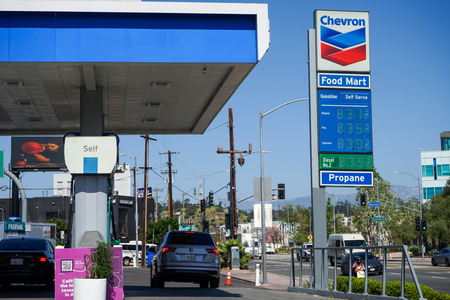
The conflict’s economic impact is already being felt in the United States, where gasoline prices have begun rising sharply.
Meanwhile, a group of US lawmakers has introduced legislation aimed at reducing fuel costs for consumers.
Senators Mark Kelly and Richard Blumenthal, along with Representative Chris Pappas, introduced the Gas Prices Relief Act, which would temporarily suspend the federal gasoline tax to ease pressure on households.
The proposal would suspend the 18.4-cent-per-gallon federal gas tax until October 1, 2026, an effort designed to reduce the price motorists pay at the pump while global energy markets remain unstable.
“Suspending the federal gas tax would help bring prices down and give families some much needed relief,” Kelly said.
Under the proposal, the US Treasury Department would monitor fuel prices to ensure oil companies pass the tax savings to consumers rather than absorbing them as profits.
Energy analysts say such policy steps could provide temporary relief but may not fully offset global market shocks if tensions in the Middle East escalate further.
–IANS
lkj/as