




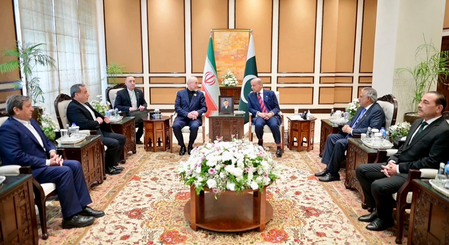
Kabul, April 13 (IANS) Pakistan’s mediating role between the United States and Iran resembled that of a courier rather than a mediator, lacking leverage, proposed solutions, and the ability to push both sides toward compromise. Pakistan acted as a diplomatic channel through which big powers like China communicated their positions without any direct engagement, a report highlighted on Monday.
“The world watched with a mixture of relief and surprise on April 8 when the United States and Iran agreed to a two-week ceasefire, with Pakistan credited as the ‘mediator’ that made it possible. Islamabad’s standing rose overnight in the diplomatic arena. Field Marshal Asim Munir received much of the credit, and Prime Minister Shehbaz Sharif received congratulatory calls from Macron, Erdogan, and the UN Secretary-General. However, beyond the optics, a more complex picture emerges, in which Pakistan functioned less as a mediator shaping outcomes and more as a well-positioned courier carrying messages between two major powers, the United States and China,” a report in Afghanistan’s leading news agency, Khaama Press, detailed.
According to the report, just days after Pakistani Foreign Minister Ishaq Dar’s visit to Beijing, the elements of the China-Pakistan joint peace proposal for resolving the West Asia conflict emerged in the ceasefire framework accepted by both Washington and Tehran.
The proposal avoided positions that could impose “diplomatic costs for Beijing, focusing on the Strait of Hormuz”, a key Chinese concern, while leaving “more contentious political issues” vague.
The report noted that for US President Donald Trump, openly acknowledging Chinese assistance would have been politically difficult, as it could signal dependence on Beijing’s influence over Tehran.
For China, assuming a prominent role entailed reputational risks, as “Beijing has historically been cautious about high-profile diplomatic engagements where failure could be damaging”, the report detailed.
“Pakistan bridged this gap. It provided the United States with a partner it could publicly acknowledge and China with a discreet channel through which its influence over Iran could operate without attracting attention. Dar’s visit to Beijing likely involved discussions on securing China as a guarantor for any agreement, and Pakistan would not have pursued such discussions without prior coordination with both Washington and Beijing. In practice, Tehran would likely look to Beijing as the ultimate guarantor of any agreement with Washington,” the report mentioned.
Asserting that “urgency and access” do not equate to mediation, the report said, “Pakistan’s role is better understood as that of a diplomatic courier. The underlying structure of the ceasefire, including proposal sequencing, guarantor arrangements, and the management of Iranian expectations, appears to have been shaped as much in Beijing as in Islamabad.”
–IANS
scor/as