



Colombo, Nov 3 (IANS) The drug crisis in Pakistan’s Karachi is now seen in missing railings, damaged bridges, stolen electrical cables and traffic signals that are now dysfunctional. The already fragile infrastructure of Karachi becomes a threat to residents when people extract steel from public infrastructure to sell in the scrap market and earn money, a report has detailed.
“The drug crisis in Pakistan’s Karachi is no longer confined to the people struggling with addiction or the neighbourhoods where narcotics are openly consumed. It is increasingly visible in damaged bridges, missing railings, stolen electrical cables and traffic signals that no longer work,” a report in Sri Lanka’s ‘Daily Mirror’ stated.
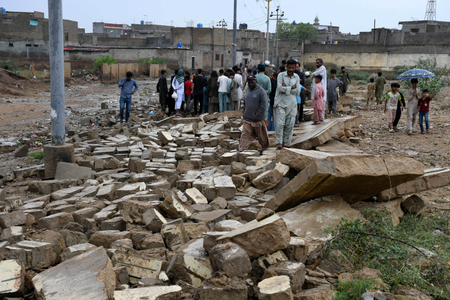
“When people strip steel from public structures to sell as scrap, the consequences extend far beyond petty theft: the city’s already fragile infrastructure becomes a threat to the people who depend on it every day. Recent incidents have exposed the scale of the problem. In September 2026, five men died when a dilapidated government school wall collapsed in Orangi Town as they were allegedly trying to extract steel rods,” it added.
In September, as many as five people were killed after a school wall collapsed in Orangi town in Pakistan’s Karachi after they were allegedly trying to extract steel rods. In October, reports claimed that 33 traffic signals did not work in Karachi due to cable theft. The incident highlights a troubling pattern which combines addiction, organised demand for stolen materials, weak implementation and worsening public infrastructure. The drug problem in Karachi raises questions about who supplies the drugs, who earns profit from stolen materials and why it has become difficult to stop damage to essential public assets.
The death of five men in Orangi town highlighted the connection between drug addiction and theft of infrastructure. Police said that these men had gathered near a school to consume drugs and were allegedly trying to extract steel from a wall when it collapsed, Daily Mirror reported, citing Pakistan-based daily Dawn.
Another report claimed that the theft of public infrastructure was widespread across Karachi, with railings removed from roads, parks and pedestrian bridges. Several areas in Karachi have faced theft of streetlight equipment, gas meters, electric cables, brass fittings and manhole covers, Daily Mirror reported, citing another Pakistan-based daily, The Express Tribune.
Damage to public infrastructure, including pedestrian bridges and flyover structures, was reported in Karachi in September. In August last year, the Natha Khan Bridge on Shahrah-e-Faisal in Karachi suffered damage after steel reinforcement was allegedly removed, creating a large pothole and disrupting traffic. The continual incidents in Karachi spark questions about how stolen materials from public infrastructure enter the scrap market, and people who buy them face meaningful scrutiny.
“Neither incident alone captures the full extent of Karachi’s drug problem. Together with the recurring damage reported across bridges, roads and neighbourhoods, however, they show how the consequences extend well beyond those directly affected by substance dependence,” a report in Daily Mirror stated.
“When a stolen cable disables a traffic signal or missing steel weakens a bridge, the damage becomes a public safety issue. Karachi’s drug crisis is no longer visible only in the lives of people struggling with addiction. It is also etched into the city’s streets, crossings and public structures,” it added.
In July, Karachi was ranked as the world’s fourth least liveable city on the Economist Intelligence Unit’s (EIU) annual Global Liveability Index 2026, placing it 170th among 173 cities. The only cities which have been ranked below Karachi are Dhaka, Damascus and Tripoli, Dawn reported.
The EIU’s ranking provides a globally recognised benchmark for urban liveability and resilience and assesses measuring indicators like healthcare, stability, culture and environment, education and infrastructure. It assesses the challenges presented to a person’s lifestyle in any given place.
Karachi received an overall ranking of 43 out of 100, and it scored 20 on stability, 54 on healthcare, 36 in culture and environment, 75 in education and 52 in infrastructure.
–IANS
akl/as