



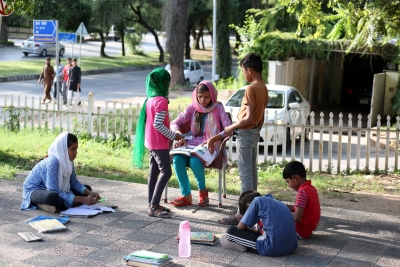
Islamabad, Jan 29 (IANS) Pakistan’s education system falters at the transition from primary to secondary education, where a girl completing Grade 5 encounters “an invisible wall”. With distant middle schools, unsafe transport, male-dominated teaching staff and hesitant families, girls are left behind after primary school, while the state failed to act, a report said on Thursday.
Writing for Pakistani daily, The Express Tribune, Nishat Riaz, Chief Executive of Malala Fund Pakistan, said that this is not a failure of ambition — Pakistan’s girls have hunger for learning as they have braved floods, conflict and poverty to attend school — but encounter a system that stops halfway and calls it achievement.
“In Pakistan, we have become very good at celebrating beginnings – a new school building, a photograph of smiling girls holding textbooks; a ribbon-cutting ceremony with media coverage. We excel at these moments: the promise, the optimism, the perfect photograph and media coverage. These moments matter. But they have also allowed us to look away from a harder truth: far too many girls disappear from education just when it should begin to change their lives,” Riaz stated.
“The key findings of the upcoming ‘Status of Girls’ Education in Pakistan’ Report shows that at the primary level, some progress is visible. Yet beyond these early years lies a familiar and troubling pattern I have seen across Pakistan: girls who start school with confidence and ambition quietly vanish from classrooms as they reach adolescence. They do not drop out. They are pushed out,” she added.
According to the report, although teacher shortages are only part of a wider structural challenge, the real weakness in Pakistan’s education system is not enrollment — it is retention.
“There are far fewer middle and secondary schools than primary ones, and they are often located at distances that are simply unrealistic for girls. Distance is not neutral. It intersects with safety concerns, unpaid care work, social expectations, and poverty. Without safe transport or nearby schools, the constitutional promise of education quietly expires around the age of ten,” it detailed.
“What we offer instead is basic literacy enough to read, but not enough to lead. Enough to comply, but not enough to challenge. This is where stopping early becomes an injustice. And yet, for too long, we have treated primary education as if it is sufficient for girls. It is not. A girl who can read has a skill. A girl who completes secondary education has choices,” it mentioned.
Highlighting the depleting condition of secondary education in Pakistan, the report further said, “No nation thrives by leaving half its population behind at adolescence. If we are serious about girls’ education, we must move beyond symbolism and into systems.
–IANS
scor/as