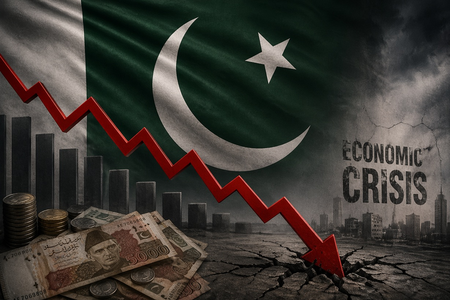
New Delhi, May 7 (IANS) Pakistan could face an economic shock of up to $68 billion if the conflict in the Middle East persists and the Strait of Hormuz remains closed for an extended period, according to a presentation by the Policy Research Institute of Market Economy (PRIME) to the National Assembly Standing Committee on Finance.
The report cited by Business Recorder outlined three possible scenarios to assess the economic fallout of the war on Pakistan.
In the first scenario, where hostilities ease quickly and the Strait of Hormuz reopens soon, the estimated economic cost to Pakistan is around $10 billion, equivalent to 2.5 per cent of the country’s GDP.
The second scenario assumes the conflict continues for another three months, significantly increasing the economic burden to between $24 billion and $32 billion, or nearly 8 per cent of GDP.
In the worst-case scenario, involving a prolonged closure of the strategic waterway and a sharp rise in crude oil prices to $150 per barrel, the total cost could surge to between $50 billion and $68 billion, equivalent to nearly 17 per cent of GDP.
PRIME’s analysis focuses primarily on the impact on Pakistan’s external sector, including rising import costs, declining exports, and lower remittance inflows.
The report warned that these pressures could sharply weaken the country’s balance of payments position and drain foreign exchange reserves, potentially triggering a financial crisis despite the presence of an IMF programme.
Pakistan’s current foreign exchange reserves stand at around $15 billion, limiting its ability to finance a widening current account deficit.
The report cautions that the financing gap in the severe scenario could become unsustainable.
Inflationary pressures are also expected to intensify. The report estimates inflation could reach around 10 per cent even in the mild scenario, while a prolonged crisis could push inflation to between 15 per cent and 18 per cent, driven largely by currency depreciation and rising food and energy prices.
–IANS
pk