




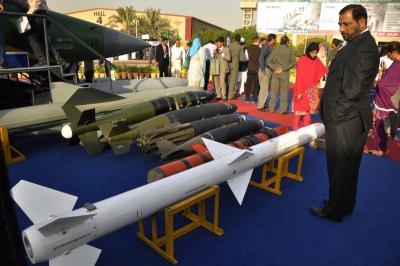
Vienna, March 2 (IANS) Pakistan is steadily emerging as a key collaborator and promoter of Chinese defence systems amid growing global concerns about the performance of China’s military equipment in real-time operations.
Under joint production and co-branding frameworks – most notably the JF-17 Thunder multirole combat aircraft developed by the Pakistan Aeronautical Complex and China’s Chengdu Aircraft Corporation – Beijing maintains a low public profile, while Islamabad serves as the system’s “operator, exporter, and political advocate”, a report highlighted recently.
“Technical or operational shortcomings are thus primarily attributed to Islamabad, not Beijing. For example, in recent export projects, such as reports of deliveries to forces in eastern Libya, Pakistan is formally listed as the contracting partner. Final assembly takes place at the Pakistan Aeronautical Complex (PAC) in Kamra, and the aircraft type is not even part of the regular inventory of the Chinese Air Force,” a report in an Austria-based news website, ‘Militar Aktuell’ detailed.
The report stated that JF-17 Thunder, referred to as the FC-1 Xiaolong in China, was designed as an affordable alternative to Western aircraft such as the Eurofighter, Gripen, or F-16, while enabling countries with limited budgets to access modern air combat capabilities.
However, it said, the operation exposed tensions between ambition and resilience.
“According to publicly available data, the Pakistani Air Force experienced several non-combat-related total losses under routine conditions between 2011 and 2024. While accidents in military flight operations are not uncommon, the clustering of incidents in the early years of service suggests structural or systemic weaknesses, including reports of cracks in the vertical stabiliser,” the report noted.
It highlighted that Chinese arms facing performance problems in real-world scenarios are raising international doubts about China’s credibility as a reliable global arms supplier.
In the wake of the US military operation in Venezuela in early January, it said, significant flaws of the deployed Venezuelan air defence systems became apparent – including systems of Chinese origin.
“Venezuela had invested heavily in Chinese radar networks, particularly in the JY-27 series long-range and anti-stealth radar systems, which were promoted at international arms fairs such as Airshow China in Zhuhai and IDEX. These long-wave radars are theoretically considered especially suitable for detecting modern fighter jets with reduced radar signatures. However, during the operation, they apparently showed no discernible effect,” the report mentioned.
“No official statements have been issued so far, and public reports remain contradictory. A combination of several factors is likely: possible operational inactivity or technical failures, deficiencies in integration and training, and effective electronic countermeasures by the US armed forces. In any case, the JY-27 systems, whose unit price is typically in the tens of millions of euros, have failed to demonstrate their advertised capabilities,” it added.
–IANS
scor/as