




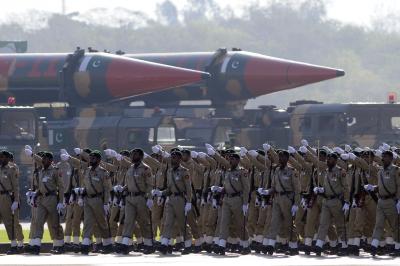
New Delhi, July 12 (IANS) Pakistan remains a deeply volatile nuclear power, with its “First Use” doctrine and military-dominated command structure contributing to an increasingly precarious security environment, according to a report.
Pakistan’s nuclear posture rejects the No First Use (NFU) doctrine, showing a possibility that Islamabad launches a nuclear strike first in a conflict scenario, a report by Fair Observer noted, citing a former senior military official.
“The country’s nuclear arsenal is intended to respond to all forms of perceived threats from an adversary. Its strategy is guided by full-spectrum deterrence, explicitly aimed at countering India across every level of conflict — strategic, operational and tactical. Former Pakistani military strategist Khalid Ahmed Kidwai said the doctrine was designed to ensure full coverage of the Indian landmass and (India would have) ‘no place to hide’,” the report said.
The Constitutional Amendment of 2025 places control of Pakistan’s nuclear operations with the Chief of Defence Forces, which dramatically expands military power.
“This reform makes Pakistan the only nuclear-armed state where authority over nuclear use is entrusted to one military officer,” the report highlighted.
According to it, international concern was sparked over Pakistan engaging in the development of Tactical Nuclear Weapons (TNWs), lowering the nuclear threshold.
“Analysts warn that their deployment in conventional military conflicts significantly increases the risk of a ‘use it or lose it’ dilemma and unauthorised launch by lower-level commanders, raising the likelihood of a full-scale nuclear war,” the report emphasised.
The report says that Pakistan also has a dangerous legacy of nuclear proliferation. Islamabad started developing a nuclear bomb in the 1970s after Abdul Qadeer Khan “stole classified information, sensitive centrifuge technology and nuclear blueprints while working as a subcontractor for URENCO in the Netherlands”.
According to the report, he established a network with private suppliers for nuclear and missile-related technologies.
“By the 1990s, Khan had operationalised the world’s most dangerous nuclear black market, fueling the secret ambitions of Iran, North Korea, and Libya while even making overtures to Iraq. His network provided Tehran with critical P-1 and P-2 centrifuges, along with the designs, and traded enrichment hardware and centrifuges with Pyongyang. In Libya, Khan’s network attempted to export a turnkey nuclear programme involving weapons designs and over a million components,” the report detailed.
After confessing the transfer of nuclear technology to Iran, Libya, and North Korea in 2004, Khan was pardoned by then Pakistani President Parvez Musharraf.
“Multiple international analysts and non-proliferation experts have argued that Khan’s global nuclear trafficking network could not have operated for decades without at least tacit support or knowledge from elements within Pakistan’s military and intelligence establishment… One such report claimed that many Pakistanis believed Khan had taken the blame to shield the wider establishment, particularly the military,” noted the report by Fair Observer.
–IANS
ksk/vd