




Washington, Jan 27 (IANS) As the international community focuses on demilitarising Hamas in Gaza, overlooking Pakistan’s growing role as a potential safe haven risks enabling the group to reconstitute outside the Middle East. Against this backdrop, proposals to deploy Pakistani troops to Gaza – whether for stabilisation or peacekeeping – are “fraught with danger”, a report has highlighted.
According to a report in the US-based Middle East Media Research Institute (MEMRI), the well-documented nexus between Hamas and terror groups Lashkar-e-Taiba (LeT) and Jaish-e-Mohammad (JeM) operating openly on Pakistani soil could undermine the credibility and clarity of international counterterrorism efforts, endangering both regional stability and Western security interests.
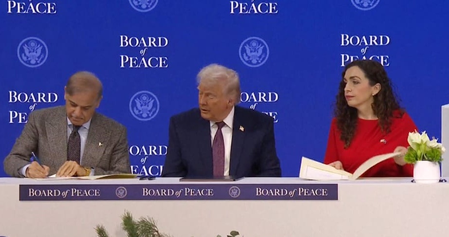
“On January 15, 2026, the US-led intergovernmental organisation Board of Peace, whose stated purpose is to ‘promote stability, restore dependable and lawful governance, and secure enduring peace in areas affected or threatened by conflict’ in Gaza, was established. On January 18, US President Donald Trump, acting as chair of the organisation, invited Pakistani Prime Minister Shehbaz Sharif to join it. However, Pakistan allows Hamas representatives to operate freely on its soil, participate in public events, and forge alliances with local militant groups,” the report detailed.
“This conduct undermines Western efforts to diplomatically isolate Hamas and raises serious questions about whether the United States should continue to regard Pakistan as a ‘major non-NATO ally’,” it added.
The report stressed that the videos and images circulating from recent events in Pakistan, including the January 2026 LeT-linked gathering in Pakistan’s Gujranwala, featuring senior Hamas representative Naji Zaheer with LeT operative Rashid Ali Sandhu – highlighted the growing nexus between Hamas and Pakistan-based terrorist groups.
Similar trends, it said, emerged earlier in 2025 during conferences held in Pakistan-occupied Kashmir (PoK), such as the February 5 “Kashmir Solidarity and Hamas Operation ‘Al Aqsa Flood’ Conference” in Rawalakot, which saw participation from representatives of LeT, JeM, and Hamas.
“These public appearances go beyond symbolic solidarity. Speakers offered mutual endorsements and rhetoric that framed the Palestinian cause, as championed by Hamas, and the Kashmiri cause, as pursued by groups such as LeT and JeM, as interconnected fronts within a broader pan-Islamic jihadist struggle,” the report mentioned.
“The visual record of these events provides tangible evidence of ideological convergence and emerging coordination, while the permissive environment in which they occur highlights Pakistan’s role as a facilitating hub for transnational militant networks. The open networking of sanctioned terrorist actors on Pakistani soil raises serious questions about state tolerance and potential complicity,” it noted.
–IANS
scor/as