



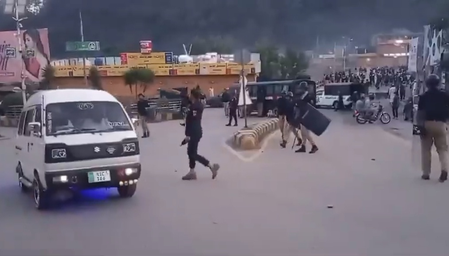
New Delhi, June 11 (IANS) Indian and international agencies have warned of a potential humanitarian crisis in Pakistan-occupied Kashmir (PoK), a region that has recently witnessed killings and widespread protests. Officials caution that the situation could escalate into large-scale human rights violations if urgent measures are not taken.
The Pakistani establishment is unlikely to engage with the protesters and is instead expected to intensify efforts to suppress the agitation. Security forces have already been accused of using excessive force, with reports claiming that scores of protesters have been killed, including 19 children and seven pregnant women.
An official said that the Joint Awami Action Committee (JAAC) has shown no signs of backing down. What began in Muzaffarabad has steadily spread to other parts of PoK. The movement has now reached Rawalakot, where large crowds and vehicle convoys have gathered and are awaiting further directions from the organisation’s leadership.
While the Prime Minister of PoK has been told to hold direct negotiations with the JAAC, the reality is something else.
An Intelligence Bureau official said that the approval to hold direct negotiations with the protesters is only a way of buying time. “Something more sinister is being planned under the leadership of Pakistan’s army chief, Field Marshal Asim Munir,” the official said.
The protests are intensifying with each passing day, and the decision to go on for as long as possible is because negotiations in the past have failed and promises have remained unkept. Another official said that for Munir, it is an ego battle now. Even if the negotiations take place, he will not allow the establishment to honour it. For him, the only way out is crushing the dissent, and for this, he is ready to use any amount of force.
This is why the agencies fear that the human rights violations will mount to a scale that has not been seen before.
Munir has had several emergency meetings with the top military brass in the past 48 hours. He has pulled up officials and asked them why they were not able to contain the protests. Munir decided that peace will only come by using force and not through political negotiations.
An official explained that with the army chief pre-deciding everything, the decision to allow the PoK Prime Minister to negotiate is not just meaningless, but also a time-buying exercise. The Pakistan army chief wants to send a clear signal to the people of PoK that they should surrender themselves to the establishment.
“More protests would only mean more atrocities is the message that Munir wants to send out,” an official said.
In addition to the killings, the establishment is also disconnecting power and water supply to scores of households across the region. This is to ensure that the people apply pressure on the JAAC to stop the protests, as their basic amenities are getting disrupted.
Officials say that the JAAC appears to be in no mood to relent despite the action against the people. It has decided to carry on with the protests for as long as it can. It has not even made a single move to meet with the PM of PoK.
The JAAC has maintained that any dialogue can take place only if the authorities first accept its core demands. Foremost among these is the lifting of the ban imposed on the organisation. The Pakistani establishment, however, is unlikely to concede this demand, as it continues to classify the JAAC as a terrorist organisation. Observers note that this approach mirrors Pakistan’s stance in Balochistan, where groups such as the Balochistan Liberation Army are designated as terrorist organisations.
Analysts and security experts argue that designating an organisation as a terrorist outfit provides the Pakistan army with legal and political justification for the use of force, including killing, against its members. Such a classification also strengthens Pakistan’s position internationally, as authorities can frame their actions as measures necessary to safeguard national security. This makes it more difficult for sections of the international community and human rights organisations to challenge such actions, as Pakistan maintains that it is acting against groups it considers a threat to the State.
–IANS
vn/snj/skp