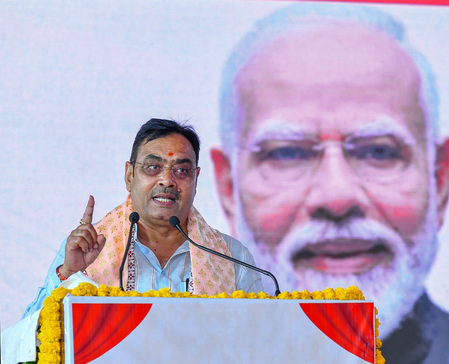




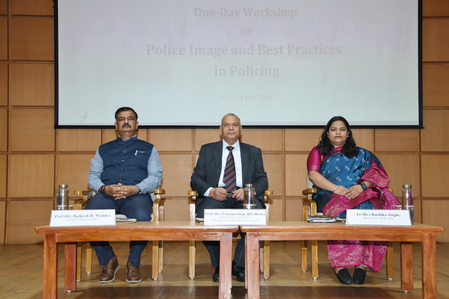
Gandhinagar, July 14 (IANS) A positive image of the police is earned through ethical conduct and public service rather than publicity, former Uttar Pradesh Director General of Police Prof. (Dr.) Vikram Singh said on Tuesday while addressing a one-day workshop on Police Image and Best Practices in Policing at Rashtriya Raksha University’s School of Internal Security and SMART Policing (SISSP).
The workshop, held at the university’s Gandhinagar campus, brought together senior police officers, including Directors General of Police and Inspectors General, from Uttar Pradesh, Uttarakhand, Delhi, Meghalaya, Gujarat, West Bengal and Rajasthan, as well as representatives from the Union Territories of Daman and Diu and Dadra and Nagar Haveli.
Delivering the address, Singh, a retired IPS officer and former DGP of Uttar Pradesh who is now Chancellor of Noida International University, urged police personnel to move away from what he described as the colonial-era “feudal” mindset rooted in the Police Act of 1861 and adopt a more humane approach based on public trust.
“A positive police image is built not through publicity, but through consistent, ethical conduct and genuine public service, earning the trust and confidence of citizens through action rather than optics,” Singh said.
He also cautioned against relying on performative public relations exercises or unauthorised media engagements to improve the image of the police.
Highlighting the importance of women’s safety and dignity, Singh cited Kolkata Police’s “LISTEN” model and Uttarakhand Police’s safe-space reporting mechanism for women as examples of empathetic policing.
He observed that police stations had historically functioned like a “boys’ club”, discouraging many women from reporting offences.
Quoting jurist Justice V.R. Krishna Iyer’s observation that “while murder destroys the body, rape destroys the soul”, Singh urged police officers to treat victims of crime with the highest respect and apply the law impartially, particularly in domestic disputes.
He also called for a transition from “danda to data-centric” policing and encouraged the graduating cohort to serve the nation with “knowledge, integrity, and humanity”.
In his address, Prof. (Dr.) Kalpesh H. Wandra, Pro Vice Chancellor at Rashtriya Raksha University (RRU), said Indian policing was shifting from a reactive model focused on investigating crimes after they occur to a predictive system that uses technology to prevent crime, in line with the Prime Minister’s vision of SMART policing.
“India has nearly 20,000 police stations and around 2.6 million police personnel serving a population of more than 1.4 billion,” he said, but stressed that effective policing depends on public trust and citizen participation rather than the size of the force.
Wandra noted that the event, comprising 54 lectures on technology adoption, women’s safety and community outreach, reflected a broader transition towards transparent, accountable and service-oriented policing aligned with the vision of “Viksit Bharat 2047”.
Earlier, Lt. (Dr) Ruchika Singla, Director In-Charge of SISSP, said: “The university was working to build a technology-driven, citizen-centric and specialised policing ecosystem through skill development and professional training.”
She highlighted initiatives including Mission Karmayogi, programmes to promote women in policing and security, and capacity-building efforts across police ranks.
“The university’s monthly ‘Police Image’ lecture series, conducted on the 22nd of every month, had completed 54 lectures to date, helping bridge the gap between theory and practice. The initiative supports the university’s objective of advancing SMART policing under its guiding principle, ‘National Security is Supreme’,” she said.
The workshop featured technical sessions by police officers from several states, who shared policing models and operational practices from their respective jurisdictions.
Inspector General (Training) Anant Takwale of Uttarakhand Police spoke on community-oriented policing initiatives, while Deputy Inspector General (Training) Dev Ranjan Verma of Uttar Pradesh discussed the Women Power Line 1090 programme and technology-driven policing for women’s safety.
Additional Commissioner of Police Neha Yadav presented best practices followed by Delhi Police, while Administrative Officer Lakador Syiem of the Meghalaya Police Academy discussed policing initiatives in Meghalaya.
Deputy Superintendent of Police Hardik N. Prajapati shared practices adopted by Gujarat Police, Inspector Sujit Bhattacharjee of the Swami Vivekananda State Police Academy addressed public trust and policing in West Bengal, and Company Commander Toniya Sharma of the 4th RAC Battalion outlined policing practices in Rajasthan.
–IANS
mys/uk