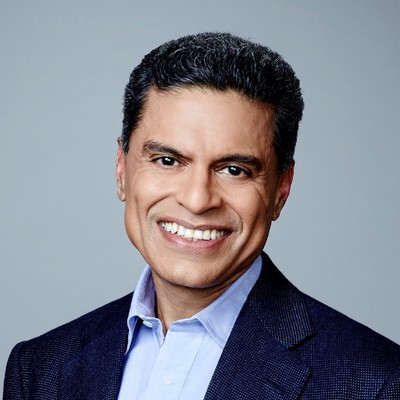
Washington, Jan 19 (IANS) India is increasingly hedging rather than aligning firmly with the United States as China deepens its global trade footprint and confidence in US leadership weakens, CNN host Fareed Zakaria said, pointing to data and opinion polls that show a broader global recalibration.
Speaking on Fareed Zakaria GPS, Zakaria said the shift was not about countries embracing Beijing’s political model but about reducing exposure to Washington’s unpredictability. India, he said, is among the major powers choosing flexibility over firm alignment.
“The world is no longer building on an American platform,” Zakaria said. “It is building around it.”
Zakaria, an influential American journalist and foreign policy commentator, said trade trends illustrate why countries such as India are hedging. China’s exports to the United States have fallen sharply, he noted, but its overall exports have continued to grow as Beijing redirects trade toward Asia, Europe, Latin America, and Africa.
China’s trade surplus rose to nearly $1.2 trillion in 2025, underscoring Beijing’s ability to absorb tariffs by diversifying markets, he noted. That resilience, Zakaria argued, has complicated Washington’s efforts to isolate China economically.
For India, the data matters. New Delhi has expanded trade with both the United States and China while resisting pressure to lock itself into any single bloc. Zakaria said that the approach reflects calculation rather than indecision.
He cited polling by the European Council on Foreign Relations showing that support for joining a US-led bloc has fallen across key emerging powers, including India, Brazil, and South Africa. In India’s case, he said, the decline reflects skepticism about American reliability, not an endorsement of China.
Zakaria said countries are hedging because recent US actions have unsettled allies. He pointed to the use of tariffs against partners and a more transactional approach to alliances as factors eroding trust.
India, he said, remains wary of China’s regional ambitions, particularly along its borders. At the same time, New Delhi is preserving strategic autonomy—deepening cooperation with Washington while keeping economic and diplomatic options open.
The trend is visible beyond Asia. Zakaria said many European countries now see the United States as an important partner rather than a dependable ally, even as they stabilize ties with China and expand trade outreach to Southeast Asia and Latin America.
China, he argued, has used the moment to build a more resilient economic ecosystem.
Zakaria said the United States still holds major advantages, including advanced technology, capital, and a wide network of allies. In theory, he said, those strengths could anchor a stable counterweight to China.
In practice, he argued, Washington is stepping back from that role. “For decades, the global order was built on an American platform,” he said. “That platform still exists, but the world is no longer building on it.”
For India, the implications are immediate. As US-China rivalry intensifies, New Delhi is positioning itself to benefit from both relationships while avoiding permanent entanglements—an approach Zakaria said is increasingly common across the Global South.
The result, he said, is a faster move toward a multipolar world driven less by ideology and more by pragmatism, with India among the countries shaping that balance rather than choosing sides.
–IANS
lkj/rs