



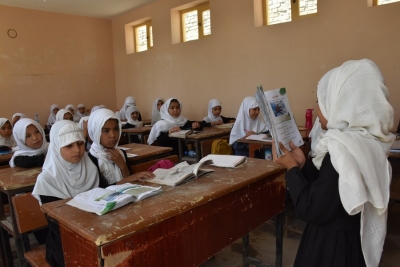
Kabul, Jan 27 (IANS) The United Nations Children’s Fund (UNICEF) stated on Tuesday that over 90 per cent of 10-year-old children in Afghanistan cannot read a simple text. It warned that education system in Afghanistan is at a critical point, with children not even receiving basic learning, the local media reported.
Citing UNICEF, Afghanistan’s leading news agency Khaama Press reported that more than 90 per cent of 10-year-olds cannot read a simple text, reflecting a crisis of schooling without learning. It mentioned that the education system in Afghanistan has been severely impacted by school closures, lack of qualified teachers and curriculum limitations since Taliban seized power on August 15, 2021.
According to the UNICEF and UNESCO report, approximately 2.2 million adolescent girls do not have access to school. UNICEF stressed that continuous investment in early education, literacy and numeracy is needed to ensure that all children are successful and escape generational illiteracy. The organisation warned that the crisis will continue in Afghanistan if reforms are not made, Khaama Press reported.
On January 24, girls above sixth grade and female university students urged the Taliban regime to allow them to study in schools and universities in the coming academic year, local media reported.
Since seizing power in August 2021, Taliban has imposed a ban on girls’ education beyond the sixth class. Later in the same year, Taliban ordered public and private universities to halt the education of girls and women until further notice. However, Taliban officials said that girls will be allowed to study after conditions are conducive.
Speaking to Pajhwok Afghan News, Madina Ahmadi, a resident of Kabul, said, “It has been four years since we were deprived of going to school. Four years ago, I was studying in eighth grade and always dreamed of finishing school and taking the Kankor entrance exam.”
She urged Taliban to reopen schools for girls. “My request from the Islamic Emirate is that, while observing Islamic principles and hijab, they allow us to return to school. We girls also want to play an active and constructive role in society, just like our brothers,” Pajhwok Afghan News quoted Ahmadi as saying.
Salma, a resident of Kabul’s Deh Mazang said, “Four years ago, when the Islamic Emirate took control, I was a ninth-grade student at Rakhshana High School. If we had not been banned from attending school, I would have graduated by now.” She voiced concern over being denied access to education and urged Taliban to reopen schools for girls above sixth grade.
Saeedia Masoodzada, a resident of Kabul’s Taimani, stated, “When girls were banned from educational institutions, I was a second-year student at the Faculty of Economics at Kabul University. Unfortunately, I am still confined to my home, and there is no news about the resumption of our classes.”
–IANS
akl/as