




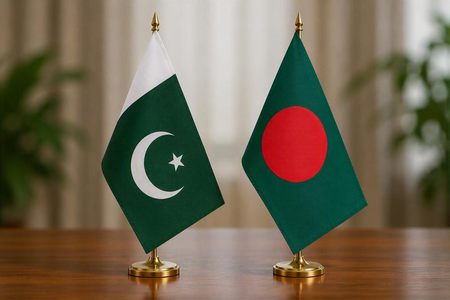
New Delhi, Oct 31 (IANS) As Bangladesh and Pakistan deepen engagement after years of limited contact, questions are emerging over what tangible benefits Dhaka stands to gain from the renewed relationship particularly amid a persistent trade imbalance and unresolved historical issues, a report has said.
As per analysis by Daily Waadaa, recent months have seen increased exchanges between the two countries.
Pakistan’s national carrier-linked connectivity has expanded, ships from Karachi are regularly arriving at Chattogram, scholarship programmes have been announced and official, private-sector delegations have travelled in both directions, it added.
However, trade figures underscore a stark imbalance.
The report also highlighted that Pakistan’s exports to Bangladesh stood at $67.2 million in fiscal year 2025–26, which reflects an approximately 11-to-1 trade ratio in favour of Pakistan based on State Bank of Pakistan data (compared to $71.6 million out in the preceding year).
Much of Pakistan’s exports to Bangladesh comprise cotton and textile raw materials that have become more competitive due to the depreciation of the Pakistani rupee, it added.
Bangladesh has repeatedly sought tariff concessions for jute and jute products, a sector in which it enjoys a dominant supplier position.
While Pakistan imports nearly all of its raw jute and jute yarn from Bangladesh, significantly higher duties are imposed on value-added jute products, limiting Bangladeshi access to the market.
Industry representatives say the tariff structure has contributed to a sharp decline in Bangladesh’s jute earnings from Pakistan in recent years.
The report also noted that Pakistan has publicly discussed raising exports to Bangladesh substantially, while no comparable target has been articulated for Bangladeshi exports to Pakistan.
While Bangladesh performs strongly on several international digital indicators, Pakistan has made notable progress in connecting financial institutions, digital wallets and government services through shared platforms.
According to the report, such institutional and technological cooperation may ultimately offer greater value than trade alone.
However, it cautions that Dhaka will need to balance those potential benefits against unresolved historical disputes, market access concerns and the domestic political sensitivities that continue to shape relations between the two countries.
–IANS
ag/